



What's Happening?
Genesis AI, a robotics company operating in California and Paris, has successfully raised $500 million in Series A funding, achieving a post-money valuation of $3.5 billion. This significant investment, co-led by Premji Invest, Khosla Ventures, and Eclipse,
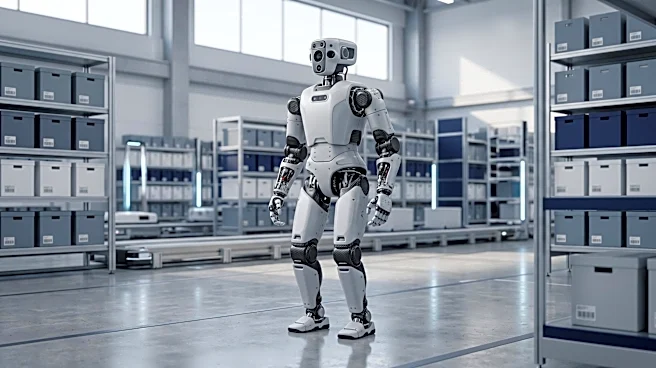
with additional contributions from investors like Durable Capital Partners, T. Rowe Price Associates, Nvidia, and AMD Ventures, is earmarked for accelerating the development and commercialization of its general-purpose robots. The company plans to utilize these funds to expand robot production, enhance data collection and AI training, and recruit more researchers and engineers. Genesis AI is currently increasing the production of its Eno robot, initially targeting applications in manufacturing, logistics, and laboratories, with future plans to expand into hospitality, healthcare, and other sectors. Co-founder and CEO Zhou Xian emphasized the company's goal to build a reliable, general-purpose robot for real-world, day-to-day operations.
Why It's Important?
This substantial funding round for Genesis AI underscores a growing investor confidence in the potential of general-purpose robotics and artificial intelligence to transform various industries. The company's focus on developing robots capable of performing complex, multi-step tasks autonomously across diverse environments could significantly impact labor markets and operational efficiencies in the U.S. and globally. By integrating human demonstration data, simulation, and real-world operational experience, Genesis AI aims to overcome current limitations in industrial automation, where many production facilities lack the infrastructure for autonomous robot learning. The involvement of prominent individual investors, including former Google CEO Eric Schmidt and Zoom CEO Eric Yuan, highlights the perceived strategic importance and disruptive potential of Genesis AI's technology, signaling a shift towards more versatile and adaptable robotic solutions in the American economy.
What's Next?
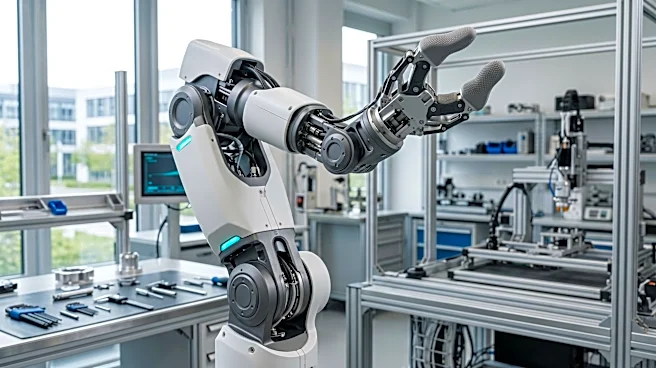
Genesis AI intends to use the newly acquired capital to scale up the production of its Eno robots and further develop its integrated robotics platform. This platform includes GENE, an AI foundation model for robotic manipulation, and Genesis World, a simulation platform for training and evaluating robotic capabilities. The company also plans to enhance its data collection methods, including a dexterous robotic hand and a data collection glove designed to transfer human movements into robot training. The immediate focus is on expanding into manufacturing, logistics, and laboratory applications, with a strategic vision to penetrate hospitality and healthcare sectors. This expansion suggests a future where Genesis AI's robots could become integral to a broader range of U.S. industries, potentially leading to increased automation and efficiency across various service and production environments.
Beyond the Headlines
The development of general-purpose robots by companies like Genesis AI represents a significant step towards a future where AI-driven machines can adapt and perform a wide array of tasks, moving beyond specialized industrial applications. This evolution raises profound questions about the future of work, the ethical implications of autonomous systems, and the societal adjustments required as human-robot collaboration becomes more prevalent. The company's approach of combining human demonstration with AI training suggests a hybrid model of development that could lead to more intuitive and adaptable robots. However, it also highlights the ongoing challenge of creating AI that can truly understand and replicate the nuances of human dexterity and problem-solving in unstructured environments. The success of Genesis AI could set a precedent for how future robotic technologies are developed, funded, and integrated into the fabric of daily life and industry.