



What's Happening?
The Weyerhaeuser Company, a prominent logging business, significantly expanded its operations and influence following the devastating Yacolt Burn of 1902 in Washington state. Founded in 1900 by Frederick Weyerhaeuser, the company initially owned 900,000
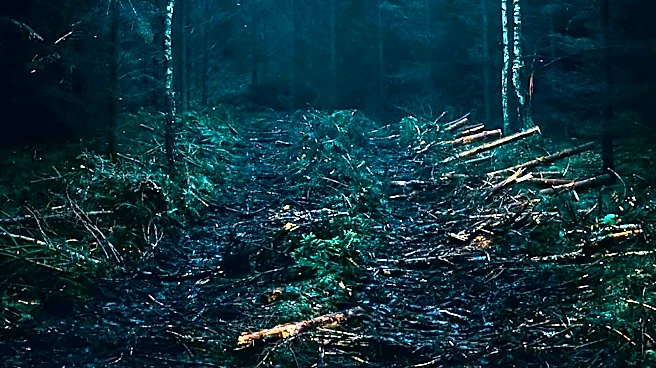
acres of land with no immediate plans for harvesting. However, the Yacolt Burn, which scorched 20,000 acres of Weyerhaeuser's timber, prompted a strategic shift. To mitigate potential losses, the company engaged in extensive salvage logging, harvesting burned-out trees that could still be processed into usable lumber. Over the subsequent two decades, Weyerhaeuser salvaged up to 75 million board feet annually. This large-scale salvage operation was instrumental in propelling Weyerhaeuser's rise to become the dominant logging business in the region and one of the most significant in the United States. The company's expansion also led to its active lobbying for statewide fire prevention legislation and funding for forest-protection associations, advocating for fire suppression as a core forestry principle.
Why It's Important?
Weyerhaeuser's response to the Yacolt Burn had a profound and lasting impact on the U.S. logging industry and forest management policies. The company's successful implementation of salvage logging established a precedent for recovering value from fire-damaged timber, influencing industry practices for decades. Furthermore, Weyerhaeuser's lobbying efforts played a crucial role in shaping early 20th-century fire prevention legislation and the establishment of forest-protection associations. This advocacy fostered a widespread belief that wildfire was detrimental to forestry and needed to be eradicated, leading to the development of fire lookouts and the U.S. Forest Service's 10:00 a.m. rule for fire extinguishment. This shift in policy, heavily influenced by logging interests, fundamentally altered the approach to forest management in the Pacific Northwest and beyond, prioritizing fire suppression over natural ecological processes.
What's Next?
The legacy of Weyerhaeuser's early practices and the fire suppression policies they championed continue to influence contemporary forest management debates. While salvage logging remains a technique, its environmental impacts, such as disruption of ecosystem dynamics, increased erosion, loss of organic carbon, and negative effects on cavity-nesting species, are now subjects of ongoing scientific study and public discussion. Future discussions will likely revolve around balancing economic recovery from wildfires with ecological preservation and the development of more resilient forest ecosystems. The long-term consequences of a century of fire suppression, including forests that are now more susceptible to severe burns, will continue to drive policy adjustments and research into alternative forest management strategies that integrate controlled burns and other natural processes.
Beyond the Headlines
The story of Weyerhaeuser and the Yacolt Burn highlights the complex interplay between economic interests, natural disasters, and environmental policy. The company's strategic response to the fire not only secured its commercial success but also inadvertently contributed to a paradigm of fire suppression that has had significant ecological consequences. This historical context reveals how a singular event can trigger a cascade of decisions that shape an entire industry and its relationship with the environment for over a century. The ethical implications of prioritizing timber recovery over natural ecological processes, and the long-term impact on forest health and biodiversity, are critical considerations that extend beyond immediate economic gains. It underscores the need for a holistic understanding of ecosystems when formulating resource management policies.