





What's Happening?
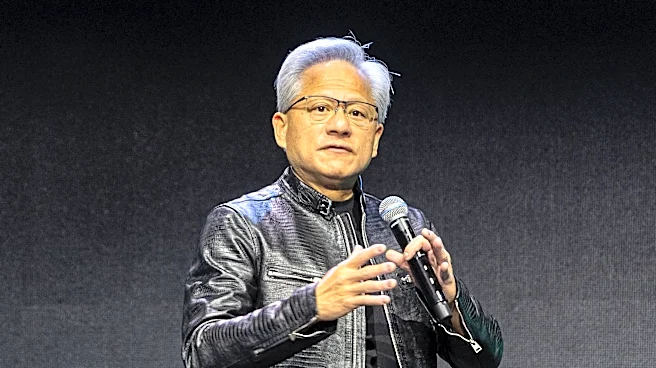
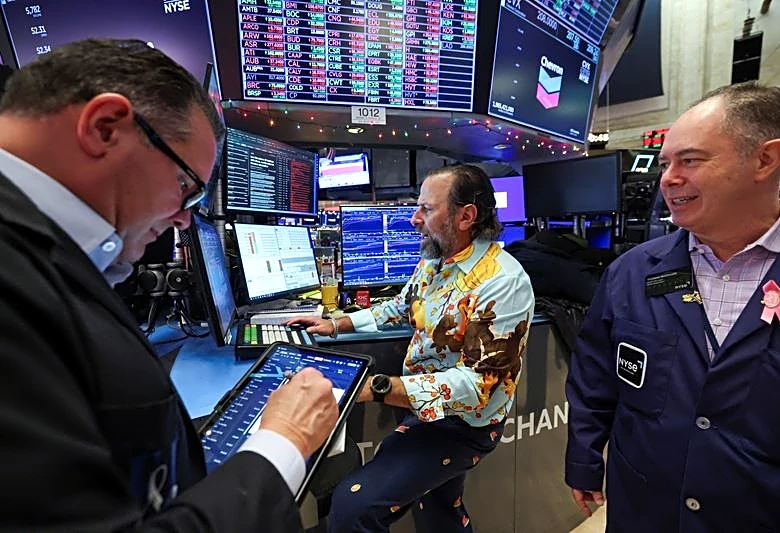
Jensen Huang has returned as CEO of Nvidia, a move that triggered a significant surge in the tech company's stock, increasing its value by nearly $1 trillion in a single day. This boost also contributed to a broader rally in the stock market. Investors
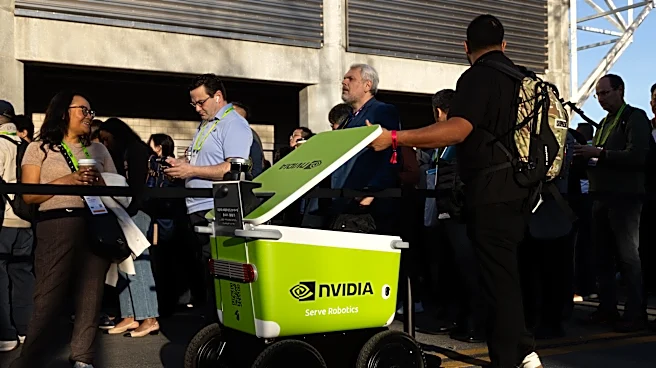
have expressed strong confidence in Huang, viewing him as integral to Nvidia's value, despite previous scandals. Nvidia plays a crucial role in the artificial intelligence economy, with its chips powering a vast majority of AI workloads, from self-driving cars to humanoid robots. Huang is seen as a key figure in articulating the potential of AI to investors, emphasizing its capacity to create high-paying jobs and fundamentally transform the economy. The company's influence extends to circular financing deals, such as its arrangement with CoreWeave, a data center company that relies on Nvidia chips and receives support from Nvidia to ensure its stability.
Why It's Important?
Jensen Huang's return and the subsequent market reaction underscore the immense influence of key leadership figures in the technology sector, particularly in rapidly evolving fields like artificial intelligence. Nvidia's dominant position in the AI chip market makes it a critical player in the global economy, with its technology underpinning numerous advancements across various industries. The surge in Nvidia's stock highlights investor confidence in the AI sector's future growth and Huang's vision for it. The company's interconnectedness with other AI-focused businesses, such as CoreWeave, illustrates the complex financial ecosystem supporting AI development. Nvidia's scale and technological indispensability raise questions about its systemic importance, with some drawing parallels to the 'too big to fail' concept, given its foundational role in AI infrastructure.
What's Next?
Following Jensen Huang's reinstatement, Nvidia is expected to continue its aggressive push in the artificial intelligence market, further solidifying its position as a leading provider of AI computing solutions. The company will likely maintain its strategy of investing in and supporting companies within the AI ecosystem, such as data centers and cloud providers, to ensure the widespread adoption and utilization of its chips. Investors will closely monitor Nvidia's performance and Huang's leadership for continued growth and innovation in AI. The broader implications for the stock market include sustained interest in AI-related stocks, potentially driving further investment and development in the sector. However, the company's relatively low forward earnings multiple suggests that while investors are confident in Huang, they may not be predicting exponential growth in the immediate future.
Beyond the Headlines
The narrative surrounding Jensen Huang's return to Nvidia extends beyond financial metrics, touching upon the intricate relationship between corporate leadership, technological advancement, and national economic strategy. Nvidia's near-monopoly in AI chips presents both opportunities and challenges, including potential national security implications due to the critical nature of its technology. The market's willingness to overlook past controversies for the sake of perceived value and leadership highlights the intense competition and high stakes in the tech industry. This situation also brings to the forefront discussions about the concentration of power within a few key technology companies and their leaders, and how this influences innovation, market dynamics, and broader societal development. The reliance of the AI economy on Nvidia's technology suggests a future where technological infrastructure providers hold significant sway over global progress.