







What's Happening?
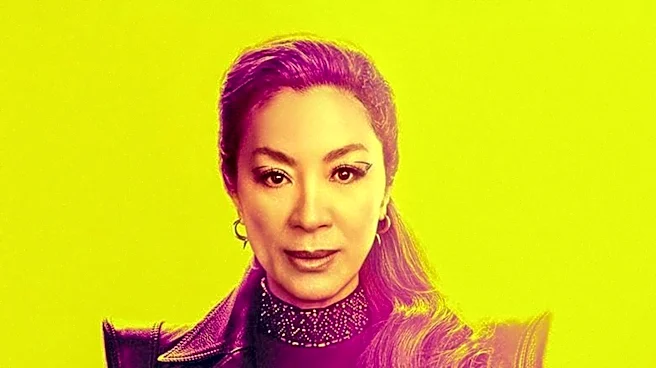
Michelle Yeoh, who stars as Olwen in the upcoming Prime Video limited series 'Blade Runner 2099,' has indicated that viewers may not need prior knowledge of the original 'Blade Runner' films to understand the new series. According to Yeoh, the show is
designed to be a standalone story that introduces its narrative in a way that is accessible to new audiences. 'Blade Runner 2099' is set 50 years after the events of 'Blade Runner 2049' and follows Cora, a fugitive Blade Runner, and Olwen, a Replicant nearing the end of her life, as they track down a dangerous secret. The cast also includes Hunter Schafer as Cora, Dimitri Abold, Lewis Gribben, Matthew Needham, and Johnny Harris, with Silka Luisa serving as creator and showrunner. Ridley Scott is an executive producer, and the series is set to premiere on Prime Video on November 25, 2026, with all eight episodes available in over 240 countries.
Why It's Important?
Michelle Yeoh's statement regarding the accessibility of 'Blade Runner 2099' is significant for the entertainment industry, particularly for established franchises. By designing the series to be understood by new viewers, the creators are aiming to broaden the audience beyond existing fans, which is a crucial strategy for expanding a franchise's reach and commercial viability. This approach can attract a younger demographic who may not have seen the original films, thereby injecting new life and interest into the 'Blade Runner' universe. For Prime Video, this strategy could lead to increased subscriptions and viewership, as it lowers the barrier to entry for a potentially large audience. It also reflects a growing trend in Hollywood to create standalone stories within larger cinematic universes, balancing fan service with the need to appeal to a wider, contemporary audience. The success of this approach could influence how other long-running franchises develop their future installments.
What's Next?
With the premiere of 'Blade Runner 2099' scheduled for November 25, 2026, on Prime Video, the immediate next step will be the global release of all eight episodes. The series' performance will be closely watched by industry analysts and fans alike, particularly regarding its ability to attract new viewers as Michelle Yeoh suggested. If the series successfully draws in a broad audience, it could pave the way for further expansions of the 'Blade Runner' universe, potentially including additional seasons, spin-offs, or even new film adaptations. The critical reception and audience engagement will also be key factors in determining the future trajectory of the franchise. Furthermore, the show's approach to storytelling, emphasizing accessibility for newcomers, might become a model for other established franchises looking to refresh their appeal and reach a wider demographic.
Beyond the Headlines
The decision to make 'Blade Runner 2099' accessible to new viewers, as highlighted by Michelle Yeoh, has deeper implications for the evolution of storytelling in long-standing franchises. It reflects a strategic shift away from relying solely on existing fan bases, acknowledging that new generations of viewers may not have the historical context of older films. This approach can be seen as an attempt to democratize access to complex fictional worlds, making them less intimidating and more inviting. Ethically, it promotes inclusivity by not requiring extensive prior knowledge, which can be a barrier for many potential viewers. Culturally, it signifies a recognition that narratives must adapt to changing consumption habits and audience expectations, where instant gratification and self-contained stories are often preferred. This could lead to a broader trend where franchises prioritize compelling, standalone narratives that also enrich a larger universe, rather than solely catering to established lore, ultimately shaping the future of serialized content.