







What's Happening?
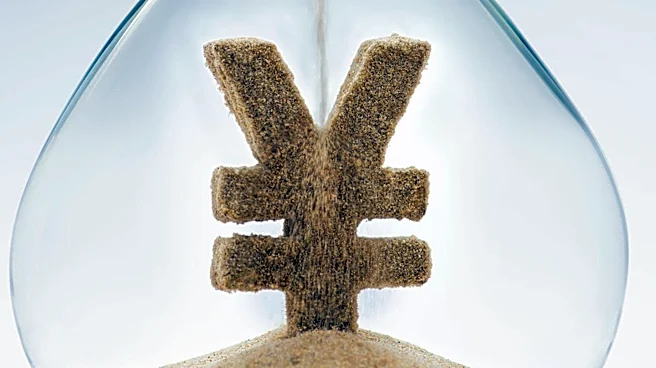
Janney's October Investment Perspectives, authored by Michael Levin, AWMA™, CLTC®, and Chief Investment Strategist Mark Luschini, delves into key financial strategies and market trends. The report examines the 'yen carry trade,' a strategy where investors
borrow in Japanese yen due to low interest rates and invest in higher-yielding assets globally. It also analyzes the anatomy of a rate-hike cycle, contrasting the aggressive Federal Reserve actions of 2022, driven by high inflation, with the anticipated cycle in 2026. The 2022 cycle saw short-term interest rates rise from effectively zero to 5.25%–5.50% in sixteen months, leading to significant bond market declines. Additionally, the report addresses the stock market's performance in October, noting its historically 'undeservedly bad reputation' despite the S&P 500's slight loss in September 2026.
Why It's Important?
The analysis of the yen carry trade is crucial for understanding global capital flows and currency dynamics, particularly for U.S. investors seeking higher returns in a low-yield environment. The discussion on rate-hike cycles provides vital context for U.S. bond market participants, highlighting how Federal Reserve policies directly impact investment strategies and asset valuations. The aggressive rate hikes in 2022, a response to inflation peaking at 9.1%, underscore the sensitivity of financial markets to monetary policy. For U.S. investors, understanding these cycles is essential for managing risk and positioning portfolios. The report's insights into historical market behavior, such as the October 1987 crash, serve as a reminder of potential volatility and the complex interplay of economic factors, including valuations, interest rates, trade deficits, and geopolitical events, on market performance.
What's Next?
The report suggests that while the Federal Reserve has embarked on another rate-hike cycle in 2026, it is expected to differ significantly from the 2022 cycle. This implies that investors should anticipate a different market response and adjust their strategies accordingly. The ongoing dynamics of the yen carry trade will continue to be influenced by interest rate differentials between Japan and other developed markets, requiring continuous monitoring by global investors. As the U.S. economy navigates potential future rate adjustments and global financial shifts, the insights provided in such investment perspectives will be critical for financial advisors and their clients in making informed decisions and planning for various market scenarios.
Beyond the Headlines
The detailed examination of the yen carry trade and rate-hike cycles reveals deeper implications for financial stability and global economic interconnectedness. The historical success of the yen carry trade, often fueled by Japan's prolonged deflation, highlights how unique national economic conditions can create arbitrage opportunities with systemic risks. The aggressive U.S. rate hikes in 2022, while necessary to combat inflation, also exposed vulnerabilities in bond markets, demonstrating how rapid policy shifts can lead to significant asset revaluations. This underscores the delicate balance central banks must maintain between controlling inflation and preventing market dislocations. The report implicitly suggests that understanding these complex financial mechanisms is not just about maximizing returns but also about recognizing the potential for cascading effects across international markets and the broader economy.