








What's Happening?
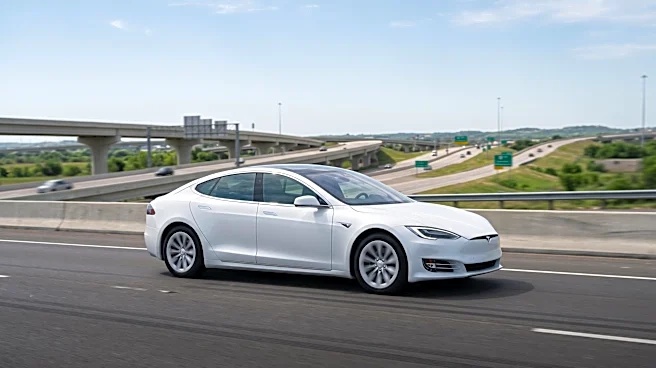
Tesla's Robotaxi service has expanded its operations into Fort Worth, Texas, joining existing services in Austin, Dallas, and Houston. This expansion, reported by Not a Tesla App and TeslaNorth, marks another milestone for the company's autonomous transportation
platform. However, the announcement has left investors with unanswered commercial questions regarding fleet size, pricing, and potential connectivity between the Dallas and Fort Worth service areas. These details are crucial for assessing the potential revenue contribution of the expanded service. Tesla's stock (TSLA) traded lower, down 0.52% at $401.71, following the news, indicating investor caution despite the geographic expansion. The company's valuation, with a price-to-earnings ratio of 441.93, suggests high earnings expectations, making concrete evidence of profitability from Robotaxi operations essential for investor confidence.
Why It's Important?
The expansion of Tesla's Robotaxi service is a critical step in the company's strategy to evolve beyond an EV manufacturer into an AI-powered transportation and robotics entity. The success of this initiative could unlock significant recurring revenue streams through ride-hailing services, diversifying Tesla's business model and reducing its reliance on vehicle sales. For the U.S. transportation sector, a scalable Robotaxi service could revolutionize urban mobility, offering autonomous, on-demand transportation. This could impact traditional taxi services, ride-sharing companies, and public transit systems. However, the lack of detailed commercial information, such as fleet utilization and operating costs, makes it challenging for investors to gauge the profitability and scalability of the service. The high valuation of Tesla's stock means that any perceived vagueness in the Robotaxi's commercial progress can lead to investor skepticism and downward pressure on share prices. Demonstrating a clear path to profitability is vital for sustaining investor interest and realizing the full potential of this ambitious venture.
What's Next?
The immediate focus for Tesla will be to provide more transparency and concrete data on the commercial performance of its Robotaxi service. Investors will be looking for metrics such as paid rides per vehicle, utilization rates, and operating costs to assess whether geographic expansion is translating into a profitable business. Future announcements regarding fleet size, pricing models, and the integration of service areas will be crucial. The company's next earnings reports will likely include updates on the Robotaxi's progress and its contribution to overall revenue. Regulatory developments concerning autonomous vehicle operations in various cities and states will also play a significant role in the pace and scope of future expansions. The market will be watching for evidence that Tesla can effectively scale its autonomous ride-hailing platform and generate substantial earnings from it, moving beyond the initial phase of deployment.
Beyond the Headlines
The expansion of Robotaxi services raises broader questions about the future of urban infrastructure and employment. Widespread adoption of autonomous ride-hailing could lead to a reduction in private car ownership, transforming city planning and parking needs. It could also significantly impact the livelihoods of professional drivers in the taxi and ride-sharing industries. From a technological standpoint, the continuous development and deployment of Robotaxi services will push the boundaries of AI and machine learning in real-world applications, addressing complex challenges in navigation, safety, and human-robot interaction. The ethical and legal frameworks surrounding autonomous vehicles, particularly concerning liability in accidents, will continue to evolve as these services become more prevalent. Tesla's approach to data collection and privacy within its Robotaxi network will also be a critical area of public and regulatory scrutiny, shaping the public's trust in autonomous technologies.