
What's Happening?
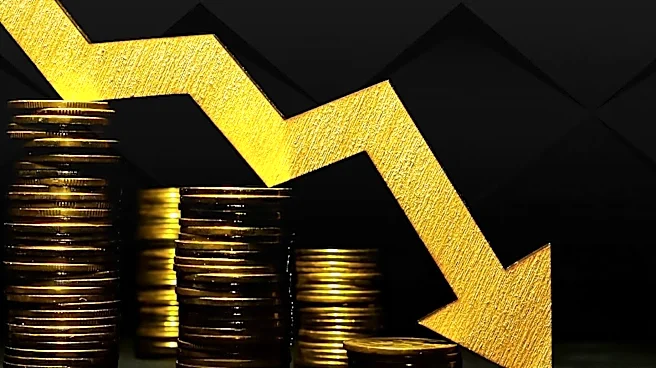
Gold futures experienced an accelerated slide on Thursday, with December gold futures closing at $3,627.30, down $100.50 or 2.70%. This marks a second consecutive triple-digit loss, with gold having seen
four $100+ declines over the past seven trading sessions. The contract is now trading approximately $2,150, or 37%, below its record near $5,780 set in late January. This selloff is primarily attributed to rising U.S. Treasury yields, particularly the 10-year yield, which has consistently stayed above 5% since a hotter-than-expected CPI report. The increase in yields makes non-yielding assets like gold less attractive, as investors can earn significant returns from government bonds. While central banks continue to buy gold for geopolitical and strategic reasons, this 'patient money' is currently being overshadowed by 'hot money' leaving the market, primarily from rate-sensitive investors and funds.
Why It's Important?
The sharp decline in gold futures, driven by rising U.S. Treasury yields, signifies a significant shift in investment preferences within the U.S. financial market. For U.S. investors, the opportunity cost of holding gold has increased substantially, as 10-year Treasury yields above 5% offer a compelling alternative to a non-yielding asset. This trend is leading to substantial outflows from gold-backed exchange-traded funds (ETFs), such as the SPDR Gold Trust (GLD) and iShares Gold Trust (IAU), indicating that investors are actively reallocating capital. The situation highlights the Federal Reserve's influence on asset valuations; its hawkish stance and the resulting higher interest rates are directly impacting gold's appeal. This dynamic affects portfolio managers, financial advisors, and individual investors who must weigh the benefits of yield against traditional safe-haven characteristics.
What's Next?
The immediate focus for gold futures is the $3,500 level, which represents a significant technical support point. A sustained break below this level could lead to further declines. Conversely, a recovery above $3,700 would be the first step towards stabilization. The 10-year Treasury yield chart will be a critical indicator; a close back below 5% would signal easing pressure on gold, while a move above 5.21% could lead to further struggles. The Federal Reserve's upcoming meeting in December, while largely priced for a quarter-point hike, will be crucial for its forward guidance on future rate increases in 2027. Until the market believes rates have peaked, ETF outflows are likely to continue. Central bank buying, while steady, may not be strong enough to reverse the trend on its own.
Beyond the Headlines
The current gold selloff reveals a deeper tension between different types of market participants: 'hot money' driven by short-term yield opportunities and 'patient money' from central banks focused on long-term strategic diversification. This divergence underscores the evolving role of gold in the global financial system. While Western investors are increasingly sensitive to interest rate differentials, central banks are acquiring gold for reasons beyond immediate yield, such as geopolitical risk mitigation and reserve diversification. This suggests that gold's value proposition is becoming more multifaceted, influenced by both traditional economic indicators and broader geopolitical considerations. The rapid breaking of support levels in the gold market also highlights the psychological aspect of trading, where forced liquidations and stop-loss orders can amplify downward momentum, even on days when fundamental pressures ease.