



What's Happening?
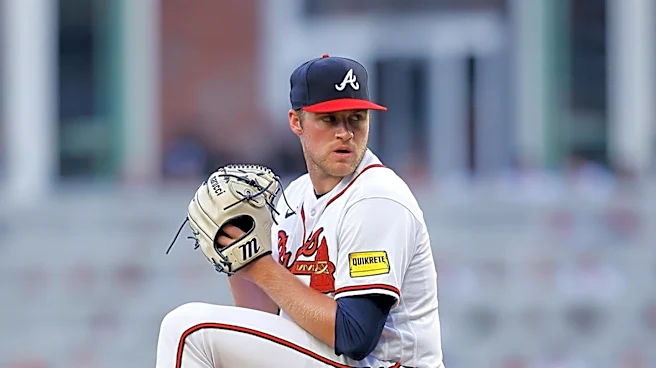
Atlanta Braves third baseman Austin Riley experienced a challenging 2026 season, but underlying metrics suggest potential for a rebound. Despite a roller coaster performance, Riley demonstrated progress, particularly in his hard-hit rate and barrel rate,
which were in the 82nd and 74th percentiles, respectively. His average exit velocity reached 91.3 mph, placing him in the 84th percentile. Post-All-Star break, his batting average on balls in play (BABIP) improved to .336, aligning with his All-Star season levels. Offensively, his OPS increased by nearly 100 points from .618 to .711, and his slugging percentage rose from .329 to .417. He also hit more home runs in the latter part of the season, with 10 in 64 games compared to 9 in the first 95 games. Defensively, Riley posted a plus-2 in outs above average (OAA), a significant improvement from his career high of zero in 2023, indicating he compensated for offensive struggles with enhanced defense.
Why It's Important?
Austin Riley's performance is crucial for the Atlanta Braves, given his long-term contract extending until after the 2032 season, with a club option for 2033, valued at $22 million per season. His ability to return to form directly impacts the team's offensive and defensive capabilities. The promising metrics, such as high hard-hit and barrel rates, suggest that when he makes contact, the ball is hit with significant force, indicating underlying power that could translate into better results with improved plate discipline. His defensive improvement is also vital, as it provides value even when his bat is struggling. For the Braves, a fully performing Riley is essential for their competitive aspirations, especially after a season where they navigated injuries and suspensions. His contract status means the team is invested in his success, making his potential rebound a key factor in their future performance and financial strategy.
What's Next?
The focus for Austin Riley in the upcoming season will be to improve his plate discipline, an area identified as a concern. His strikeout rate (31.9%) and whiff rate (31.9%) were in the third and tenth percentiles, respectively, indicating a need for adjustment. While his walk rate rebounded in 2026, the increased strikeout rate led to fewer balls in play. Riley has acknowledged the challenge of translating practice adjustments into game-time performance, stating he is trying to simplify his approach. The Braves will continue to support him in finding consistency and curbing chases at the plate. His long-term contract ensures he will have ample opportunity to work through these issues. The team's success in future seasons will partly depend on Riley's ability to refine his approach and consistently contribute at a high level, building on the positive metrics observed in 2026.
Beyond the Headlines
The situation with Austin Riley highlights the complexities of player performance in professional sports, where significant contracts are often based on past achievements and future potential. Even highly paid athletes can experience slumps, and the challenge lies in identifying the root causes and implementing effective solutions. Riley's case demonstrates that advanced metrics can offer a more nuanced understanding of a player's contributions beyond traditional statistics, revealing underlying strengths even during periods of struggle. His defensive improvement, for instance, underscores the multi-faceted value a player can bring to a team. This scenario also reflects the ongoing pressure on teams to manage player development and performance, especially for those with substantial financial commitments, and the importance of patience and strategic support in helping athletes navigate career fluctuations.