


What's Happening?
The International Chamber of Commerce (ICC) is advocating for increased certainty in global policy to unlock economic growth, a key message delivered ahead of the G20 Leaders’ Summit in December. This call comes from the B20 Summit, hosted by the U.S.
Chamber of Commerce in Washington, D.C., which focused on 'Accelerating Global Growth.' During the summit, Mr. Denton, Co-Chair of the B20 Trade Task Force, highlighted that policy uncertainty has incurred a cumulative cost of US$600 billion by the end of 2026. He emphasized the need to restore investor confidence and expand access to trade finance, particularly for small and medium-sized enterprises (SMEs), which are crucial for job creation and economic development. The ICC, representing over 45 million businesses globally, played a significant role in shaping business recommendations for the G20 process, aiming to foster an open, rules-based global economy.
Why It's Important?
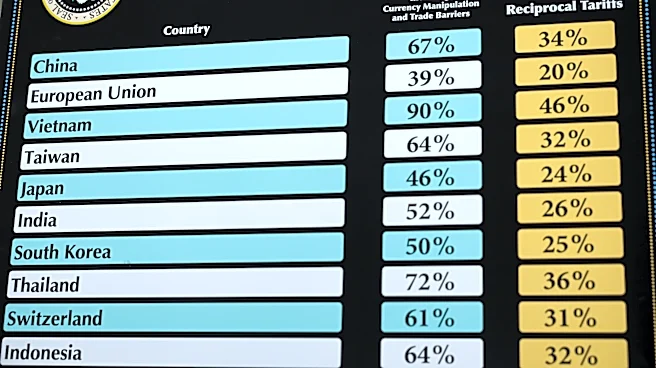
The ICC's push for greater policy certainty directly impacts U.S. businesses and the broader global economy. U.S. companies, especially those engaged in international trade, face significant challenges from unpredictable policy environments, which can deter investment and hinder growth. The estimated US$600 billion cost of uncertainty underscores the financial burden on businesses, potentially leading to reduced innovation, slower job creation, and decreased competitiveness. By advocating for a stable, rules-based global economy, the ICC aims to create a more favorable environment for U.S. exports, foreign direct investment, and the overall prosperity of American enterprises. The focus on trade finance for SMEs is particularly vital, as these businesses often struggle to access capital for international operations, limiting their ability to contribute to economic expansion and job growth within the U.S. and globally.
What's Next?
As the B20 process transitions to the G20 Leaders’ Summit in December, the ICC will continue its advocacy for an open and rules-based global economy. The recommendations formulated during the B20 Summit, including the B20 Leaders’ Statement, will be presented to G20 leaders, urging them to adopt policies that promote investment, innovation, and opportunities for businesses worldwide. The U.S. Chamber of Commerce, having hosted the B20 Summit, will likely play a role in reinforcing these messages to U.S. policymakers and international stakeholders. The outcome of the G20 Summit will indicate the extent to which these business-led recommendations are integrated into global economic strategies, potentially influencing trade agreements, investment policies, and regulatory frameworks that affect U.S. businesses.
Beyond the Headlines
The ICC's emphasis on reducing policy uncertainty highlights a deeper challenge in the current global economic landscape: the increasing interconnectedness of geopolitical events and economic stability. Beyond direct financial costs, persistent uncertainty can erode trust among international trading partners, leading to protectionist tendencies and a fragmentation of global markets. This could undermine the long-term benefits of globalization, such as efficiency gains and consumer choice. The call for expanded trade finance for SMEs also points to an ethical dimension, ensuring that smaller businesses, which are often more vulnerable to economic shocks, have the necessary resources to participate in and benefit from international trade. The success of these initiatives could foster a more equitable and resilient global economic system, benefiting a wider range of businesses and communities, including those in the U.S.