





What's Happening?
Nexstrom, a Singapore-based semiconductor startup, has successfully raised a $12 million seed funding round from investors including Xora, Foothill Ventures, and SEEDS. This latest investment brings the company's total funding to $15 million. Nexstrom is focused
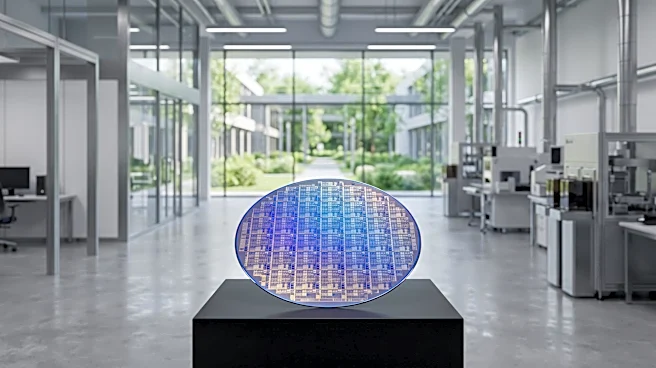
on developing technology to produce two-dimensional (2D) materials for semiconductor manufacturing at scale. The company's approach aims to address the challenges of shrinking silicon transistors by utilizing extremely thin semiconductors, known as transition-metal dichalcogenides (TMDs). Nexstrom's core technology, called North Star, is designed to grow TMDs directly on 300mm (12-inch) wafers, which are standard in commercial chipmaking. This innovation seeks to enable chipmakers to continue shrinking chip sizes and improve performance, particularly in response to the growing demand for data centers.
Why It's Important?
Nexstrom's advancements in 2D semiconductor manufacturing hold significant importance for the U.S. technology and business sectors, particularly for the global chip industry. As silicon-based transistors approach their physical limits, the development of alternative materials like 2D semiconductors is crucial for sustaining the pace of technological innovation. The ability to produce these materials at scale, as Nexstrom aims to do, could unlock new possibilities for faster, more energy-efficient, and smaller electronic devices. This directly impacts U.S. companies involved in chip design, manufacturing, and the broader electronics industry, offering potential solutions to current limitations in computing power and energy consumption. Furthermore, addressing the global component shortage, driven by demand from data centers, is vital for the U.S. economy, as it underpins advancements in artificial intelligence, cloud computing, and other critical technologies. Nexstrom's success could enhance the competitiveness of the U.S. tech sector by providing access to next-generation semiconductor materials.
What's Next?
With the new $12 million seed funding, Nexstrom plans to further develop its technology and move its equipment closer to commercial production. Key priorities include improving process control and measurement capabilities, expanding its team, and supporting qualification programs with potential customers. The company is currently focused on delivering material quality specified by industry partners and has demonstrated results on 12-inch wafers. Nexstrom expects its equipment to be ready for commercial production between 2030 and 2035. Instead of competing directly with major chipmakers like TSMC, Samsung, and Intel, Nexstrom intends to sell its technology to them or collaborate as partners. Some companies are already testing samples of Nexstrom's wafers and materials, indicating a path towards industry adoption and integration into existing manufacturing processes.
Beyond the Headlines
The pursuit of 2D semiconductors by Nexstrom and other industry players represents a fundamental shift in the future of computing. Beyond merely shrinking chips, this technology could lead to entirely new paradigms in electronics, potentially enabling devices with unprecedented capabilities in areas like quantum computing, advanced sensors, and flexible electronics. The challenge of scaling these materials from laboratory settings to commercial production highlights the immense scientific and engineering hurdles involved in pushing the boundaries of material science. The long-term implications include a potential reordering of the global semiconductor supply chain, with new materials and manufacturing processes becoming central. This could also trigger a new wave of innovation in related fields, from software development to artificial intelligence, as hardware capabilities evolve. The ethical considerations around resource consumption and the environmental impact of advanced manufacturing will also become increasingly pertinent as these technologies mature.