







What's Happening?
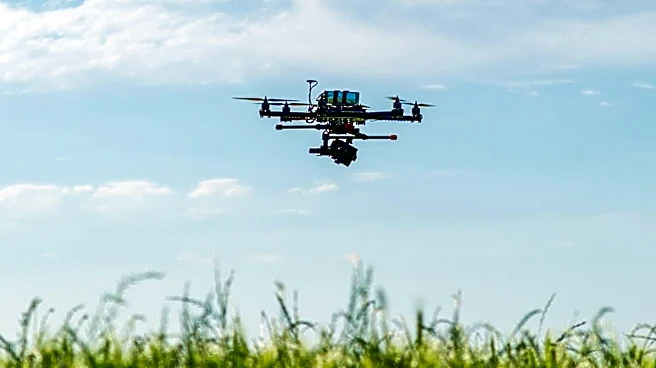
Agriculture Victoria has launched an AgTech pilot program in collaboration with Victorian AgTech company Drone-Hand to trial innovative drone and artificial intelligence technology for livestock protection. The Dingo Drone Pilot Project, set to run until
June 2027, aims to evaluate the effectiveness of aerial monitoring in enhancing on-farm protection measures for livestock producers. The trial is being conducted across two regions in Victoria. In the north-west, the technology is investigating the feasibility of monitoring wildlife exclusion fencing for breaches. In the north-east, machine-learning models are being built, trained, and validated to detect and identify dingoes on farmland. Stephen Baud, Agriculture Victoria program manager, stated that the trial seeks to provide farmers with practical tools to minimize stock losses and improve animal welfare. Edward Barraclough, founder and CEO of Drone-Hand, expressed enthusiasm for the partnership, highlighting the technology's potential as a new management tool for livestock operations facing predation challenges. This initiative builds on previous support from Agriculture Victoria's $15 million AgTech Regional Innovation Network (AgRIN) initiative, which aided Drone-Hand's growth and commercialization of autonomous drone solutions.
Why It's Important?
This AgTech pilot program holds significant importance for the agricultural sector, particularly for livestock producers facing challenges from predation and fence maintenance. By leveraging AI and drone technology, the initiative aims to reduce stock losses, which can have substantial economic impacts on farms. Improved animal welfare, a key objective of the program, also contributes to sustainable and ethical farming practices. The development and validation of machine-learning models for predator detection could set a precedent for similar applications in other regions and for different types of wildlife, potentially transforming how livestock is protected globally. The success of this proof-of-concept phase could lead to broader deployment of the technology, offering a scalable solution that integrates seamlessly into existing livestock operations. This innovation could also stimulate further investment and development in the AgTech sector, fostering economic growth and technological advancement within agriculture.
What's Next?
The Dingo Drone Pilot Project is scheduled to continue until June 2027, during which time the technology will be rigorously tested and validated. If the initial proof-of-concept phase proves successful, the next steps will involve refining the technology for broader deployment across Victorian farming properties. This refinement could include optimizing drone flight patterns, enhancing AI detection accuracy, and developing user-friendly interfaces for farmers. The success of this pilot could also encourage other agricultural regions, both within Australia and internationally, to explore similar AI-powered solutions for livestock management and protection. Furthermore, the data collected during this trial will be crucial for future research and development in AgTech, potentially leading to new applications and advancements in autonomous farming solutions. The collaboration between Agriculture Victoria and Drone-Hand may also serve as a model for future public-private partnerships in agricultural innovation.
Beyond the Headlines
The deployment of AI-powered drones in agriculture raises broader implications beyond immediate livestock protection. Ethically, the use of AI for animal monitoring could lead to discussions about data privacy in farming operations and the potential for over-surveillance. Legally, the regulations surrounding drone operation in agricultural airspace and the use of AI for decision-making in animal management may need to evolve. Culturally, the adoption of such advanced technology could represent a significant shift in traditional farming practices, potentially leading to a more tech-integrated agricultural landscape. This initiative also highlights the growing trend of precision agriculture, where technology is used to optimize resource management and improve efficiency. The long-term impact could include a more resilient and sustainable agricultural industry, better equipped to handle environmental challenges and economic pressures through technological innovation.