
What's Happening?
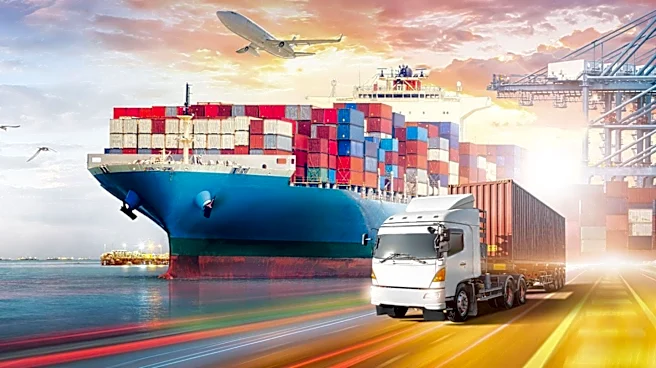
The global freight forwarding market, valued at approximately $240 billion in 2025, is projected to experience a significant slowdown in growth, with an anticipated expansion of just 2.5% in 2026. This
deceleration comes despite continued growth in the industry, which is navigating persistent geopolitical trade route disruptions and challenges stemming from shifting regional manufacturing hubs. According to Transport Intelligence’s latest report, the market is facing headwinds such as weaker trade volumes, falling freight rates, tariff uncertainties, and ongoing geopolitical instability. Sea freight, in particular, is grappling with significant overcapacity, while airfreight maintains a more balanced state. Analysts are hesitant to declare clear winners or losers, noting that performance varies widely by geography, trade lane, and business model, emphasizing the importance of financial resilience and adaptability for companies in this environment.
Why It's Important?
This slowdown in the global freight forwarding market has significant implications for U.S. businesses and consumers. A constrained or volatile freight market can lead to increased shipping costs, supply chain disruptions, and longer delivery times for goods imported into or exported from the U.S. Industries heavily reliant on international trade, such as manufacturing, retail, and e-commerce, could face higher operational expenses and challenges in maintaining inventory levels. The emphasis on financial resilience and adaptability among freight forwarders suggests that smaller U.S. businesses might struggle more than larger corporations to secure reliable and cost-effective shipping solutions. Furthermore, the ongoing geopolitical disruptions, such as the conflict with Iran and Red Sea uncertainties, directly impact U.S. trade routes, potentially rerouting shipments and adding to transit times and costs, ultimately affecting the prices consumers pay for goods.
What's Next?
The freight forwarding industry is expected to continue adapting to the challenging environment by focusing on strategic initiatives. Digital transformation, including the adoption of cloud-based automation, real-time data transparency, and AI-driven workflows, will intensify competition and attract small to mid-sized enterprises seeking greater transparency. Ocean carriers are increasingly integrating into freight forwarding, capturing a significant market share and further consolidating the industry. The rise of Chinese freight forwarders also signals a shift in global logistics power. Key drivers for future growth include the cross-border e-commerce parcel boom, particularly in North America, and evolving sourcing trends such as multi-shoring, near-shoring, and re-shoring to build supply chain resilience. Early adoption of AI for tasks like quoting, customer service, and route optimization is identified as the next game-changer, with major global forwarders building proprietary AI capabilities to gain a competitive edge.
Beyond the Headlines
Beyond the immediate economic impacts, the evolving freight forwarding landscape highlights deeper shifts in global trade and supply chain management. The move towards multi-shoring and near-shoring by U.S. companies, driven by a desire for resilience and diversification, could lead to a restructuring of global manufacturing and logistics networks. This could foster regional economic development and reduce reliance on single-source supply chains, but also potentially increase costs in the short term. The rapid adoption of AI and digital technologies is not just about efficiency; it's creating a significant divergence in capabilities between large global forwarders and smaller regional players, potentially leading to further market consolidation. Ethical considerations around data privacy and the impact of automation on labor in the logistics sector will become increasingly pertinent. The industry's response to geopolitical instability and climate change, through optimized routing and reduced emissions, will also shape its long-term sustainability and societal impact.