




What's Happening?
Artist Alvaro Barrington, originally from Brooklyn and now based in London, is discussing the profound influence of cultural life, particularly hip-hop, on American art. Barrington posits that the American contribution to art is not merely depicting modern
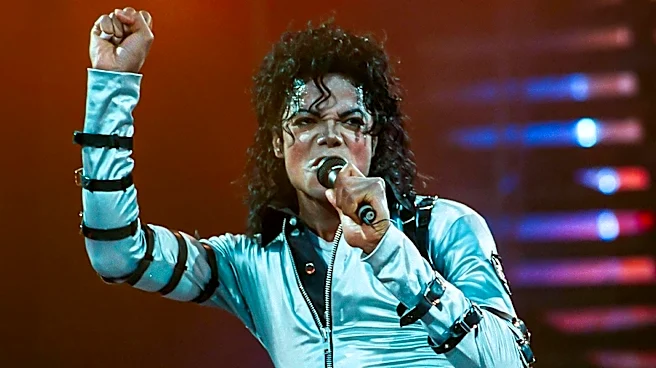
life, but rather cultural life, drawing parallels between jazz's rhythm and movement influencing Jackson Pollock's work, and disco's energy shaping Andy Warhol's paintings. He argues that artists like Michael Jackson and Prince, with works such as 'Thriller,' have created art that resonates more broadly with the public than many traditional fine art masterpieces. Barrington's perspective stems from his experience growing up during what he considers a significant cultural renaissance in the U.S., encompassing figures from Michael Jordan to Michael Jackson and Missy Elliott. He also highlights the economic disenfranchisement faced by Caribbean communities involved in London Carnival, advocating for tax breaks for costume designers and food vendors.
Why It's Important?
Barrington's insights are important for understanding the evolving landscape of art and its connection to popular culture in the U.S. His argument challenges traditional art world hierarchies by asserting that cultural phenomena like hip-hop and pop music can produce works of art with greater societal impact and recognition than those typically found in galleries. This perspective could influence how American art is valued, taught, and collected, potentially broadening the definition of what constitutes 'fine art.' The discussion also touches on the commercialization of Black cultures and the historical mechanisms through which industries have leveraged these cultures for revenue, raising questions about authenticity, ownership, and equitable compensation within creative industries. His advocacy for Caribbean communities in London also underscores broader issues of cultural economic justice.
Beyond the Headlines
Barrington's views delve into the deeper implications of art as a reflection of cultural identity and societal narratives. He suggests that to truly engage with art, one must understand the cultural story it tells. This challenges the notion of art as an isolated aesthetic experience, instead framing it as deeply embedded in social and historical contexts. His comparison of the American cultural renaissance to the Italian Renaissance elevates the significance of contemporary cultural movements, particularly those rooted in Black American experiences, to a global historical scale. The discussion also implicitly critiques the 'Whiteness Project' and 'Blackness Project' in America, highlighting how these constructs have shaped perceptions of identity and art, and how working-class Blackness became a defining frame, often erasing the diversity of Black experiences.