








What's Happening?
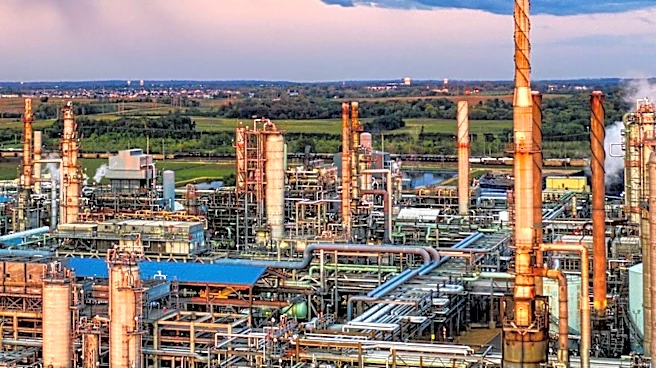
Honeywell is leveraging automation and artificial intelligence (AI) to address the challenges faced by the biofuel refining industry. As demand for biofuels increases due to decarbonization efforts, the industry struggles with feedstock variability and contamination.
Lewis Sweet, general manager for sustainable fuels and chemicals at Honeywell Process Automation, highlights the role of AI in optimizing refinery operations. AI can integrate analytics and enterprise knowledge to make informed decisions, improving the efficiency of biofuel production. This technology allows for better prediction and adjustment of reactor operations, reducing off-spec production time and costs. The integration of AI and automation is seen as crucial for meeting the rising demand for biofuels.
Why It's Important?
The integration of AI and automation in biofuel refining is significant as it addresses the bottleneck in biofuel supply, which is crucial for meeting decarbonization targets in hard-to-abate industries. By improving the efficiency and accuracy of biofuel production, AI can help refineries optimize their operations, reduce costs, and enhance profitability. This technological advancement could lead to more financially viable renewable projects, contributing to the broader goal of reducing carbon emissions. The ability to accurately calculate carbon intensity and optimize feedstock use is essential for the industry's growth and sustainability.
What's Next?
As the biofuel industry continues to evolve, the focus will likely be on further integrating AI and automation to enhance production processes. Honeywell and other industry players may invest in developing more sophisticated models to improve the accuracy of carbon calculations and feedstock management. The industry could see increased collaboration between technology providers and biofuel producers to address the challenges of feedstock variability and contamination. Additionally, regulatory frameworks may evolve to support the adoption of advanced technologies in biofuel refining, potentially leading to new standards and practices.
Beyond the Headlines
The adoption of AI and automation in biofuel refining could have broader implications for the energy sector. It may drive innovation in other areas of renewable energy production, encouraging the development of new technologies and business models. The focus on reducing carbon emissions and improving efficiency aligns with global sustainability goals, potentially influencing policy decisions and investment strategies. As the industry matures, there may be opportunities for cross-sector collaboration, leveraging AI to address similar challenges in other energy-intensive industries.