






What's Happening?
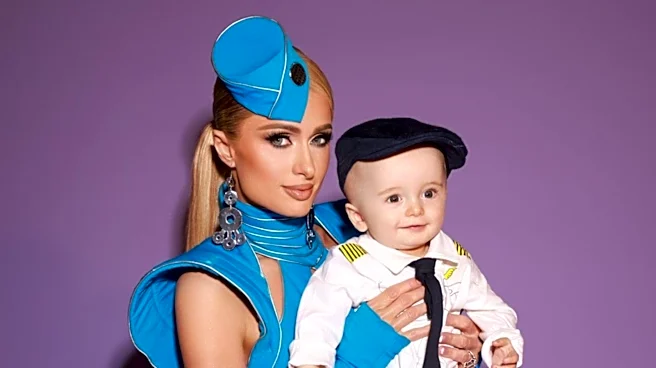
Paris Hilton has addressed criticism regarding her family's Halloween costumes, where she dressed as Belle from Disney's 'Beauty and the Beast.' Her husband, Carter Reum, was the Beast, their son Phoenix, 3, was Lumière, and their daughter London, 2,
was Chip. The socialite faced backlash on social media for portraying Belle herself, with some commenters suggesting her daughter London should have been the princess. Hilton clarified that the costume choices were based on her daughter's preferences. She explained that 'Beauty and the Beast' is one of her children's favorite movies, and London specifically requested to dress as Chip, stating it was her favorite character. This explanation was provided in the comments section of an Instagram post where the family's costumes were shared.
Why It's Important?
This event highlights the increasing scrutiny public figures face regarding their personal choices, particularly those involving their children, in the age of social media. The immediate and widespread nature of online criticism demonstrates how quickly public opinion can form and be voiced, even on seemingly innocuous topics like Halloween costumes. For celebrities like Paris Hilton, managing public perception and responding to online commentary has become an integral part of their public life. The incident also underscores the broader cultural phenomenon of Disney's enduring influence on family entertainment and costume traditions. The expectation that a young girl 'should' be the princess reflects societal norms and gender roles often associated with popular culture, which Hilton subtly challenged by emphasizing her daughter's agency in choosing a non-traditional character.
What's Next?
While this specific incident is likely to fade as a news topic, it contributes to the ongoing narrative surrounding celebrity parenting and social media engagement. Public figures will continue to navigate the balance between sharing aspects of their private lives and managing potential online backlash. For Paris Hilton, this response reinforces her public image as a mother who prioritizes her children's wishes. The broader trend of online commentary on celebrity family choices is expected to persist, influencing how public figures curate their online presence. Future social media posts from Hilton and other celebrities may continue to draw similar attention, prompting further discussions about privacy, public scrutiny, and the role of social media in shaping public discourse around personal decisions.
Beyond the Headlines
Beyond the immediate discussion of Halloween costumes, this situation touches upon deeper themes of parental autonomy versus public expectation, and the evolving nature of celebrity culture. The expectation that a mother would dress her daughter as a princess, rather than herself, reveals underlying societal pressures and gendered expectations often projected onto children's play and identity. Hilton's response, emphasizing her daughter's choice, subtly challenges these norms by asserting the child's agency and individual preference. This incident also reflects the double-edged sword of social media for public figures: it allows for direct engagement with fans but also opens the door to unfiltered criticism and judgment. It underscores how even seemingly trivial personal decisions of celebrities can become subjects of public debate, highlighting the blurred lines between public and private life in the digital age.