





What's Happening?
A sprawling Los Angeles mansion, formerly owned by actor Jeremy Renner, has been relisted on the luxury real estate market for $99 million. This price represents a $26 million reduction from its initial asking price of $125 million. The 22,000-square-foot
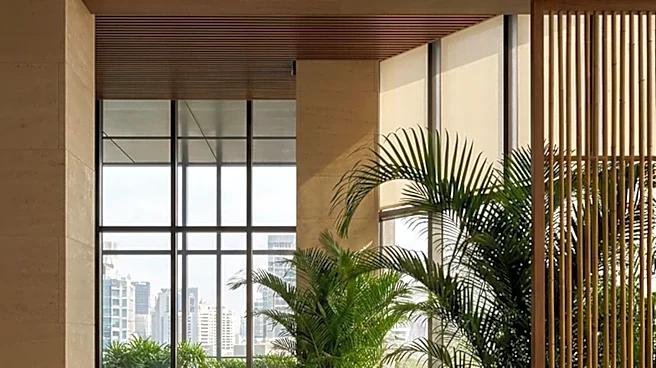
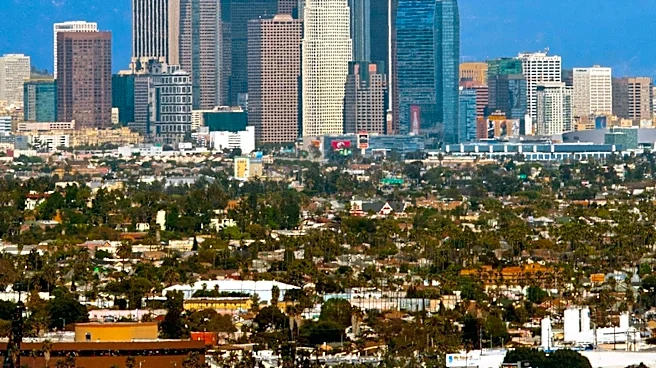
estate, located at 7661 Curson Terrace, was developed by Branden and Rayni Williams in collaboration with Scott Mitchell Studio. The property was constructed on land reportedly purchased from Renner for $8 million and took a decade to build by JRC Group. It features seven bedrooms, twelve bathrooms, a 4,000-square-foot motor court, a 100-foot infinity pool, and offers panoramic views from the city skyline to the Pacific Ocean, with private access to Runyon Canyon. The design incorporates monolithic board-formed concrete, glass, and steel curtain walls, characteristic of Scott Mitchell’s architectural style. Construction costs alone reportedly exceeded $5,000 per square foot, excluding the land value.
Why It's Important?
The re-listing of this ultra-luxury property with a significant price reduction highlights the current challenges within Los Angeles' high-end real estate market. The developers' decision to cut the price by 21% indicates a narrowing pool of ultra-high-net-worth buyers and shifting market conditions, even for trophy homes. This trend could signal a broader adjustment in the luxury housing sector, potentially affecting property values and investment strategies for developers and high-net-worth individuals across the U.S. The property's sale would also be subject to Los Angeles' Measure ULA, commonly known as the 'mansion tax,' which imposes a 5.5 percent tax on sales above $10.9 million. This tax adds a substantial surcharge to the purchase price, further influencing buyer decisions and the overall dynamics of the luxury market in the city.
What's Next?
The property will remain on the market, with its developers and real estate agents, Branden and Rayni Williams of Beverly Hills Estates, continuing to seek a buyer. The price adjustment is a strategic move to attract potential purchasers in a challenging market. Future sales in the ultra-luxury segment of Los Angeles will likely be closely watched to see if this price correction is an isolated incident or indicative of a more widespread trend. The impact of Measure ULA will also continue to be a factor in high-value transactions, potentially influencing how properties are priced and negotiated in the city. The success or failure of this sale at the reduced price could provide further insights into the resilience and future direction of the luxury real estate market in Los Angeles.
Beyond the Headlines
The extensive engineering and craftsmanship involved in this property, including over 100 caissons sunk approximately 100 feet into the ground and custom millwork, underscore the immense investment and ambition behind such luxury developments. The claim that the level of craftsmanship is 'nearly impossible to replicate today' speaks to the unique nature of these high-end constructions. However, even with such bespoke features, the market dictates the ultimate value, demonstrating that even the most exclusive properties are not immune to economic shifts. This situation also raises questions about the sustainability of ultra-luxury development in a fluctuating market and the long-term implications of high construction costs and specialized design on property liquidity and investment returns.