

What's Happening?
Keyboardist Jan Hammer recounted an incident where Jeff Beck's guitar was stolen prior to the recording sessions for their collaborative album 'Wired'. Hammer, who had picked up Beck's instruments from the airport, discovered the guitar case empty upon
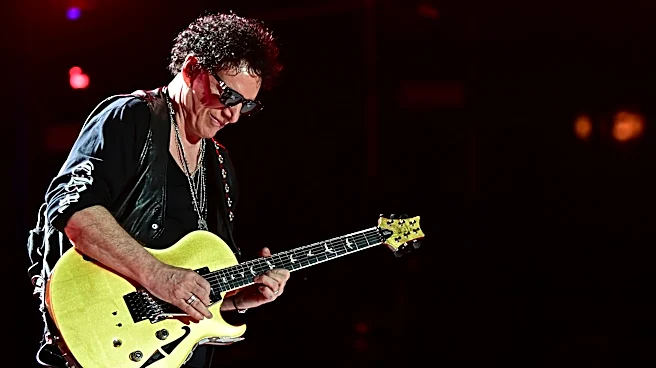
Beck's arrival. Despite the theft, Beck proceeded to record the track 'Blue Wind' using a studio-provided Fender Stratocaster. Hammer detailed his extensive career, including his early life in Prague, his studies at Berklee College of Music, and his move to New York City, where he became a U.S. citizen in 1978. He also shared anecdotes about working with other notable musicians such as Miles Davis, John McLaughlin, Al Di Meola, Tommy Bolin, Neal Schon, and Eddie Van Halen, highlighting their unique musical contributions and personal interactions. Hammer emphasized his appreciation for guitarists and how their approach to melodic improvisation and tone influenced his synthesizer playing.
Why It's Important?
This anecdote provides a unique glimpse into the challenges and improvisational spirit that can define significant musical collaborations. The theft of Jeff Beck's guitar, a critical tool for a musician, could have derailed the 'Wired' sessions, an album that became a landmark in jazz-rock fusion. Beck's ability to adapt and perform with an unfamiliar instrument underscores his exceptional talent and professionalism, contributing to the album's eventual success and influence. For music enthusiasts and historians, such details offer valuable context to the creative process behind iconic recordings. Furthermore, Hammer's reflections on his collaborations with a diverse array of legendary musicians illustrate the interconnectedness of the music industry and the cross-pollination of genres, from jazz to rock, that shaped the sound of several decades. His journey from Czechoslovakia to becoming a Grammy and Emmy Award-winning artist in the U.S. highlights the opportunities and cultural exchange within the American music scene.
What's Next?
While Jan Hammer considers himself largely retired, his reflections offer a rich historical perspective on a pivotal era in music. The stories he shares contribute to the ongoing narrative of these influential artists and their impact. Future retrospectives, documentaries, or re-releases of the music he created with these legends may draw upon such personal accounts to provide deeper insights for fans. The legacy of 'Wired' and other albums Hammer contributed to will continue to be studied and appreciated by musicians and scholars. Although no new collaborations are indicated, the enduring influence of these works ensures continued discussion and analysis within music education and popular culture. The details of such incidents, like the stolen guitar, often become part of the folklore surrounding these iconic figures, enriching their stories for future generations.
Beyond the Headlines
The incident of Jeff Beck's stolen guitar transcends a simple anecdote, touching upon the vulnerability of artists and their instruments, which are often extensions of their creative identity. The ability to perform at a high level with an unfamiliar instrument speaks to a profound mastery of music that goes beyond specific gear. This event also subtly highlights the logistical challenges inherent in touring and recording, even for established artists. More broadly, Hammer's career, marked by his emigration from Czechoslovakia due to political upheaval, underscores the role of the United States as a haven for artistic freedom and opportunity. His successful integration into the American music scene and his collaborations with a pantheon of U.S. and international musicians exemplify the melting pot of talent that has historically defined American popular music, fostering innovation across genres like jazz, rock, and fusion.