




What's Happening?
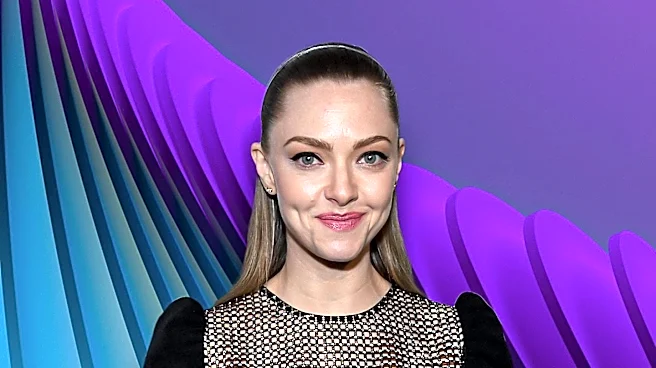
Actress Amanda Seyfried has publicly explained her decision to turn down the role of Gamora in Marvel's 'Guardians of the Galaxy' franchise, a role ultimately played by Zoe Saldaña. Seyfried stated that the MCU role was 'just not for me' and that she
made the choice 'for my family.' During a Q&A with the SAG-AFTRA Foundation, she expressed initial skepticism about the film's potential success, citing the premise of a talking tree and raccoon in space. She also mentioned her dislike for extensive makeup, stunts, heights, and pretending in front of a green screen, preferring roles with more tangible elements. Despite the film's eventual success, Seyfried maintains she has no regrets about her decision, as reported by Deadline and Yahoo Entertainment.
Why It's Important?
Amanda Seyfried's decision highlights the personal and professional trade-offs actors face in Hollywood, particularly when balancing career opportunities with family priorities and personal preferences. Her candid explanation offers insight into the demanding nature of large-scale franchise films, which often require significant time commitments for filming, promotions, and extensive physical transformations. This choice underscores a growing trend among some actors to prioritize quality of life and personal well-being over potentially lucrative blockbuster roles. It also sheds light on the subjective nature of career choices in the entertainment industry, where an actor's comfort with specific production demands can heavily influence their decisions, impacting both their individual career trajectory and the casting landscape of major productions.
What's Next?
Amanda Seyfried will continue to pursue roles that align with her preferences, likely focusing on projects that offer a balance between professional challenge and personal life. Her recent involvement in projects like Ramy Youssef's 'Martha & Muhammad' suggests a continued interest in diverse and potentially more character-driven roles. This approach may lead her to further critical acclaim in films and television series that do not require the extensive physical and time commitments of major superhero franchises. Her transparency about her decision could also influence other actors to be more selective about their roles, potentially fostering a greater emphasis on work-life balance within the industry.
Beyond the Headlines
Seyfried's comments delve into the broader implications of the superhero genre's dominance in Hollywood. Her initial skepticism about 'Guardians of the Galaxy' reflects a common sentiment among some industry professionals regarding the perceived artistic merit and long-term career impact of such films. While superhero movies often guarantee massive commercial success, they can also demand a specific type of performance and commitment that may not appeal to all actors. This situation raises questions about artistic freedom versus commercial viability and the pressure on actors to participate in franchises. Her preference for roles with 'something to hold on to' speaks to a desire for grounded, character-driven work, contrasting with the often abstract and CGI-heavy environments of large-scale blockbusters, and highlighting the diverse motivations that drive creative professionals.