


What's Happening?
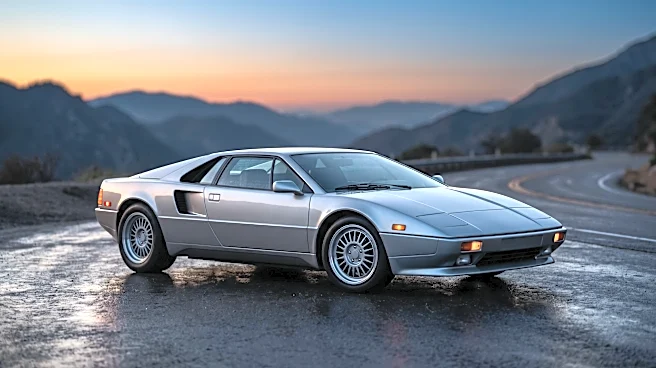
General Motors (GM) canceled the Lotus Etna supercar project following its acquisition of Lotus in 1986. The Etna, unveiled in 1984, was designed by Italdesign's Giorgetto Giugiaro and featured a mid-engine V8, advanced active suspension derived from
Formula 1 technology, and a lightweight construction. It was intended to be a revolutionary grand tourer, capable of accelerating from 0 to 96 km/h in 4.3 seconds and reaching speeds of approximately 290 km/h. The project aimed to showcase innovations such as active suspension, traction control, ABS, and active noise cancellation, which were groundbreaking for a road car in the 1980s. However, Lotus was facing severe financial instability after the death of Colin Chapman in 1982, compounded by the oil crisis, global recession, and declining sales. These factors led Lotus to prioritize more affordable models, and the Etna, along with its Type 909 engine, was ultimately shelved and then canceled by GM.
Why It's Important?
The cancellation of the Lotus Etna by General Motors highlights the significant impact corporate acquisitions can have on product development and innovation within acquired companies. For Lotus, a brand known for its lightweight and precise engineering, the Etna represented a bold step into the supercar market, potentially challenging established players like Ferrari and Lamborghini with superior technology and performance. GM's decision to cancel the project, likely driven by a strategic shift towards more affordable models and financial constraints within Lotus, meant the loss of a potentially groundbreaking vehicle that could have redefined the supercar landscape of the 1980s. This event underscores how larger corporate strategies can override the innovative ambitions of smaller, specialized brands, potentially stifling technological advancements and market diversification. The Etna's story serves as a case study in the challenges faced by niche manufacturers when integrated into larger automotive conglomerates.
What's Next?
The sole prototype of the Lotus Etna remained forgotten for 14 years before being rediscovered and restored. In 1998, it was sold to a collector, Olav Glasius, who initially believed it to be a rolling mock-up. During its restoration by former Lotus engineer Ken Myers, it was discovered that the car contained a Type 909 engine and gearbox. Myers completed the mechanical drivetrain and replaced the active suspension with restored components from an Esprit to make it drivable. The Etna was publicly 'reborn' in 2006 at the Donington Park Lotus Festival and has since appeared at events like the Goodwood Festival of Speed before joining a private collection in California. It was later auctioned at Monterey Car Week for $224,000, a price considered modest for such a unique and historically significant vehicle. The car's journey from cancellation to a collector's item demonstrates its enduring appeal and the recognition of its potential, even decades after its initial demise.
Beyond the Headlines
The Lotus Etna's story extends beyond a mere canceled project; it represents a 'what if' scenario in automotive history, showcasing the potential for innovation that was never fully realized. The car's advanced features, such as its Formula 1-derived active suspension and active noise cancellation, were revolutionary for its time and foreshadowed technologies that would become standard in high-performance vehicles much later. The decision by General Motors to cancel the project, while perhaps financially pragmatic at the time, arguably deprived the automotive world of a significant technological and design benchmark. The Etna's eventual restoration and appearance at prestigious events highlight a growing appreciation for automotive prototypes and concepts that pushed boundaries, even if they never reached mass production. It underscores the cultural value placed on engineering ambition and design foresight, even when commercial realities dictate a different path. The car's legacy is a testament to Lotus's innovative spirit and the enduring fascination with unfulfilled potential in the automotive industry.