






What's Happening?
Aeluma, Inc. has announced a letter of intent with the U.S. Department of Commerce CHIPS R&D Office for up to $30 million in funding. This investment is aimed at accelerating the development and commercialization of Aeluma's scalable photonics technology
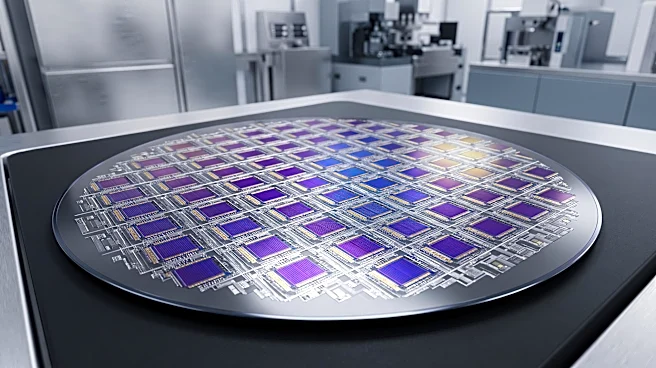
for artificial intelligence (AI) and advanced computing. The company is transitioning its focus from early-stage government research and development contracts to commercialization, particularly targeting the AI datacom market. Aeluma's strategy involves leveraging non-indium phosphide substrates, which are less prone to supply chain constraints compared to traditional indium phosphide, and are compatible with large-scale microelectronics manufacturing. The company has also expanded its workforce, more than doubling its employees, and is establishing strategic manufacturing partnerships to scale its proprietary photonics platform. This includes an agreement with Sumitomo Chemical Advanced Technologies to increase wafer production capacity and the procurement of AIXTRON G10 MOCVD systems for manufacturing.
Why It's Important?
This CHIPS Act funding is crucial for bolstering the U.S. domestic semiconductor supply chain and reducing reliance on foreign manufacturing, particularly in the critical area of AI infrastructure. The shift towards photonics in AI datacom is vital because traditional copper links struggle with bandwidth, heat, and power consumption at the scale required for advanced AI systems. Aeluma's focus on non-indium phosphide substrates addresses a significant industry bottleneck, as indium phosphide is currently in short supply, expensive, and difficult to scale for high-volume production. By developing scalable photonics solutions, Aeluma aims to enable faster, more energy-efficient data movement within AI data centers, which are projected to see capital investments reaching $1.8 trillion by 2030, with photonics accounting for 10% to 15% of that total. This initiative supports the broader U.S. goal of re-establishing leadership in semiconductor manufacturing and innovation, creating high-tech jobs, and ensuring national security in critical technology sectors.
What's Next?
Aeluma is currently in discussions with the Department of Commerce to finalize the definitive agreements for the CHIPS Act funding. While the accounting treatment is expected to be an equity investment rather than revenue, this capital will directly support the company's commercialization efforts for high-speed photodetectors and quantum dot lasers for AI datacom. The company plans to continue investing in talent, systems, and processes to support customer and product development programs. Aeluma is also negotiating multiple multimillion-dollar non-recurring engineering (NRE) agreements with commercial customers, which are expected to accelerate product qualification and commercialization. The procurement and installation of new MOCVD reactors will further expand manufacturing capabilities, positioning Aeluma to ramp up production of its proprietary processes with supply chain partners. The company anticipates capital expenditures of $10 million to $12 million for fiscal year 2027, primarily for manufacturing equipment.
Beyond the Headlines
The strategic investment in Aeluma through the CHIPS Act highlights a broader U.S. policy objective to de-risk critical supply chains and foster domestic innovation in advanced technologies. The emphasis on photonics for AI infrastructure underscores a fundamental shift in how data will be moved and processed, moving beyond the limitations of traditional electronics. This transition has significant implications for energy efficiency in data centers, which are massive consumers of electricity. By enabling more efficient data transfer, photonics can contribute to reducing the environmental footprint of AI. Furthermore, Aeluma's use of non-indium phosphide substrates and MOCVD technology represents a strategic move to overcome material scarcity and manufacturing scalability challenges, potentially setting new industry standards for high-volume production of optical components. This could lead to a more resilient and diversified semiconductor ecosystem, less vulnerable to geopolitical disruptions and material shortages.