




What's Happening?
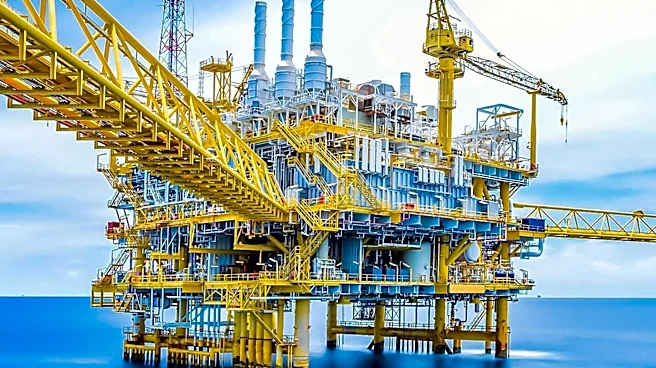
The Center for European Policy Analysis (CEPA) has proposed utilizing Romania's anticipated surplus natural gas production from the Neptun Deep project to establish a European strategic reserve in Ukraine. This initiative aims to leverage Ukraine's extensive
underground storage capacity, which exceeds its domestic needs and has previously been offered to European companies for approximately 10 billion cubic meters of space. Production from Neptun Deep, developed by OMV Petrom and Romgaz in the Black Sea, is slated to begin in 2027 and is expected to add around 8 billion cubic meters per year. CEPA's analysis suggests that even with increased domestic consumption for power plants and industrial activity, Romania could still have exportable volumes. The proposal envisions transporting Romanian gas to Ukraine when regional demand and prices are low, storing it, and then reintroducing it to regional markets as needed, functioning as both a commercial and energy security instrument. The existing infrastructure, including the Vertical Gas Corridor and reoriented Trans-Balkan pipelines, supports this concept, allowing gas flow from southern Europe to Central Europe and Ukraine, including gas from U.S. LNG terminals and Azerbaijan.
Why It's Important?
This proposal holds significant importance for European energy security and regional market integration. By creating a strategic gas reserve in Ukraine using Romanian production, Europe could enhance its resilience against supply disruptions and price volatility, particularly given past reliance on Russian gas. The initiative would diversify gas sources and storage options, strengthening the energy independence of Central and South-Eastern European nations. For Romania, it provides a strategic outlet for its increased gas production, potentially mitigating market saturation in neighboring countries like Hungary and Bulgaria, where long-term absorption capacity might be limited due to existing contracts, geopolitical factors, and the growth of renewables. For Ukraine, it reinforces its role as a critical energy hub and leverages its underutilized storage infrastructure, offering both commercial opportunities and a bolstered position in regional energy security discussions. The integration of U.S. LNG imports via the Vertical Gas Corridor further underscores the broader geopolitical implications of diversifying European energy supplies away from traditional sources.
What's Next?
The CEPA proposal is currently an analytical concept and not a finalized agreement. Moving forward, its implementation would necessitate commercial decisions, agreements between gas operators, and potentially a framework established by national governments or the European Union. Key stakeholders, including OMV Petrom, Romgaz, Ukrainian storage operators, and relevant governmental bodies, would need to engage in negotiations to define operational, financial, and regulatory aspects. The evolution of regional gas demand, the actual production pace of Neptun Deep, and the development of domestic consumption in Romania will also influence the viability and scale of such a reserve. Furthermore, the ongoing geopolitical landscape and energy policies within the EU will play a crucial role in shaping the political will and financial incentives required to transform this proposal into a concrete strategic mechanism. The continued development of the Vertical Gas Corridor infrastructure will also be essential for facilitating the efficient transport of gas to Ukrainian storage facilities.
Beyond the Headlines
Beyond the immediate energy security benefits, this proposal touches upon deeper implications for regional cooperation and infrastructure utilization. It represents a strategic re-imagining of existing energy infrastructure, repurposing pipelines originally designed for East-West flows (Russian gas to Europe) for South-North and West-East movements. This adaptability highlights a broader trend in European energy policy towards creating a more interconnected and flexible gas network. Ethically, it underscores the principle of mutual energy security, where individual national resources contribute to collective regional stability. Legally, it would require complex cross-border agreements and regulatory harmonization to ensure efficient and equitable operation of the reserve. Culturally, it could foster greater energy interdependence and trust among participating nations, strengthening regional alliances. In the long term, such initiatives could serve as a blueprint for other regions seeking to enhance energy resilience through collaborative infrastructure projects and strategic resource pooling, potentially reducing geopolitical leverage held by dominant energy suppliers.