






What's Happening?
River AI, co-founded by Igor Babuschkin, has announced that its River API has reached an annualized revenue run rate of $100 million, just five months after its launch. The company projects it will achieve a $200 million run rate by the end of the year
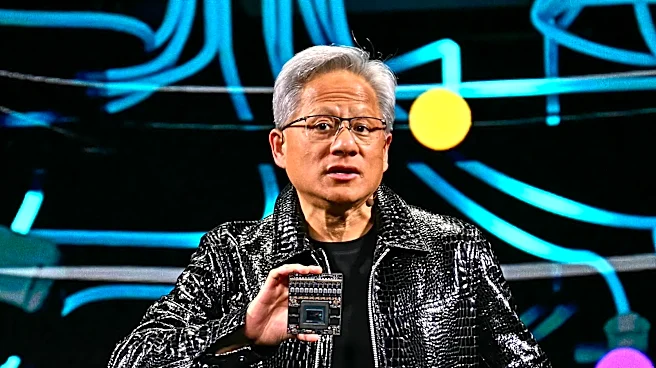
due to significant interest and demand. The River API enables companies to fine-tune and execute reinforcement learning on open-weight models without the need for extensive in-house training infrastructure. Customers are charged per token for both training and inference processes. A substantial portion of this revenue is generated from on-premises deployments of its platform. Babuschkin highlighted that River AI's system is uniquely capable of scaling to frontier-level reinforcement learning training runs out of the box. Early design partners include Perplexity, and the company received early backing from Nvidia's Jensen Huang and General Catalyst's Hemant Taneja. Microsoft AI CEO Mustafa Suleyman praised River AI's rapid progress, stating, 'Huge respect! Incredible pace! The era of startup intelligence is here.'
Why It's Important?
River AI's rapid ascent to a $100 million annualized revenue run rate underscores the escalating demand for advanced AI infrastructure and services within the U.S. technology sector. This achievement highlights the critical need for platforms that simplify and scale complex AI model training and deployment, particularly for open-weight models. The company's success indicates a significant market opportunity for specialized AI solutions that reduce the operational burden on businesses. For U.S. industries, this means greater accessibility to sophisticated AI capabilities, potentially accelerating innovation and efficiency across various sectors. Companies that leverage River AI's API can gain a competitive edge by quickly integrating and optimizing AI models without substantial upfront investment in infrastructure. The involvement of prominent figures like Jensen Huang and Hemant Taneja, along with strategic investments from Nvidia and AMD Ventures, signals strong confidence from key players in the AI and venture capital communities, further validating the market's direction towards specialized AI platforms.
What's Next?
River AI is actively scaling its operations to meet the projected demand, aiming for a $200 million annualized revenue run rate by year-end. This expansion will likely involve further development of its API and platform capabilities, potentially attracting more enterprise clients and expanding its market reach. The company's continued growth could also lead to increased competition in the AI infrastructure space, prompting other technology firms to enhance their offerings or explore similar specialized solutions. Given the rapid pace of innovation in AI, River AI's trajectory will be closely watched by investors and industry leaders. Its success could influence future investment trends in AI startups, particularly those focused on practical, scalable applications of advanced models. The company's ability to maintain its growth rate and meet its ambitious targets will be a key indicator of its long-term impact on the AI landscape.
Beyond the Headlines
The rapid success of River AI, particularly its focus on open-weight models and reinforcement learning, points to a broader shift in the AI ecosystem. The emphasis on 'open-weight' models suggests a move towards more democratized AI development, where companies can customize and deploy powerful models without being entirely reliant on proprietary, closed-source systems. This could foster greater innovation and reduce vendor lock-in, benefiting a wider range of businesses. The significant revenue generated from on-premises deployments also highlights a preference among some enterprises for greater control over their data and AI infrastructure, driven by concerns around data privacy, security, and regulatory compliance. This trend could lead to a hybrid approach to AI adoption, combining cloud-based services with on-premises solutions. Furthermore, the praise from industry leaders like Mustafa Suleyman underscores the growing recognition of specialized AI startups as crucial drivers of technological advancement, potentially reshaping the competitive landscape dominated by larger tech giants.