


What's Happening?
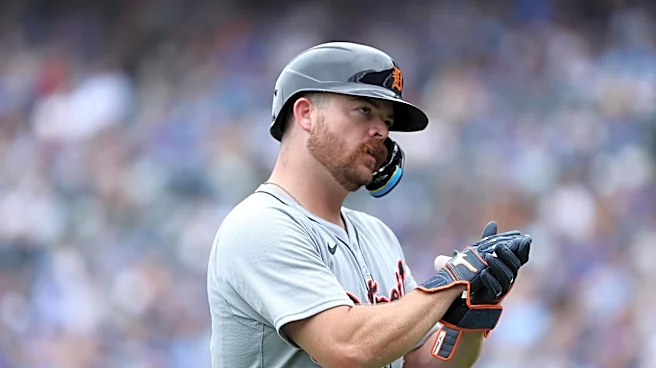
The Detroit Tigers are approaching a significant decision regarding first baseman Spencer Torkelson, with the non-tender deadline set for Friday, November 20. Torkelson, a former first overall draft pick, is under team control through 2028, with a projected
salary of $7.7 million for 2027. Despite playing in 159 games last season, hitting .230 with 26 home runs, 77 RBIs, and a .766 OPS, his production has not fully met the high expectations associated with his draft pedigree. The Tigers must decide whether to offer him a contract for the upcoming season or non-tender him, making him a free agent. Non-tendering a former No. 1 overall pick would be an unusual move for the team that drafted him, though it has occurred in MLB history with other players.
Why It's Important?
The decision on Spencer Torkelson carries substantial financial and strategic implications for the Detroit Tigers. Retaining Torkelson at his projected $7.7 million salary is considerably less expensive than acquiring a comparable first baseman on the open market, where players like Jake Bauers and Ty France are projected to command $14.5 million and $16 million annually, respectively. Opting for a more expensive external option would limit the Tigers' financial flexibility to address other critical needs, particularly in pitching. Furthermore, the team currently lacks an obvious internal replacement ready to step into the first base role, with prospect Josué Briceño still developing in Triple-A. Non-tendering Torkelson would also reflect poorly on the organization's player development given his high draft status, potentially impacting future draft strategies and public perception.
What's Next?
The Detroit Tigers must make their decision on Spencer Torkelson by the non-tender deadline on Friday, November 20. If tendered a contract, Torkelson will remain with the team for the 2027 season, and the Tigers will continue to control him through his arbitration years. If non-tendered, he will immediately become a free agent, allowing him to sign with any other MLB team. The team's choice will directly influence their payroll allocation for the upcoming season and their strategy for filling the first base position. The collective bargaining agreement's expiration on December 1 could also impact the timing of subsequent offseason moves, including arbitration filings, making the non-tender deadline a critical immediate step for the Tigers.
Beyond the Headlines
The situation with Spencer Torkelson highlights the inherent risks and pressures associated with high draft picks in professional sports. While Torkelson has shown flashes of power, his overall offensive production and high strikeout rate have raised questions about his long-term value. The Tigers' dilemma underscores the challenge of balancing player potential, current performance, and financial prudence. The decision could set a precedent for how the organization handles players who do not fully live up to their draft status. It also reflects a broader trend in MLB where teams increasingly prioritize cost-efficiency and production, even for highly touted prospects, especially when alternative options, even if more expensive, offer clearer performance metrics or defensive value.