








What's Happening?
Advanced Micro Devices (AMD) Chair and CEO Lisa Su announced on November 3, 2026, that the company now expects revenue to grow more than 80% in 2027, which is over double the long-term financial model outlined in November 2025. This revised forecast was
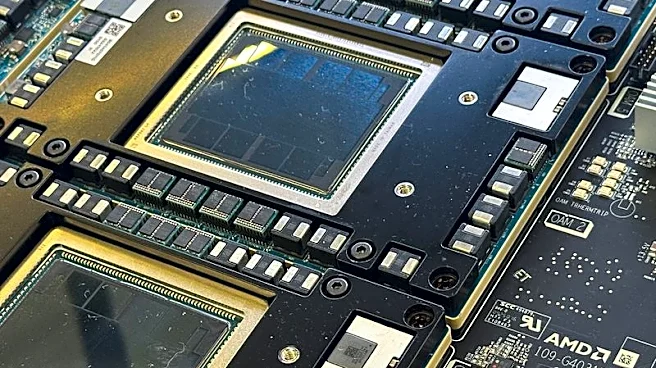
shared during the third-quarter earnings call, where Su indicated that the data center segment is projected to account for over 80% of total revenue in 2027, a significant increase from 64% in the third quarter of 2026. The company's third-quarter revenue reached $13.377 billion, up 44.68%, with data center revenue at $8.546 billion, up 97%. AMD guided fourth-quarter revenue to approximately $17.0 billion. Su attributed this accelerated growth to expanded EPYC and Instinct plans by customers and secured additional supply to meet the increased demand, particularly from lead customers like Anthropic, Meta, Microsoft, OpenAI, and Oracle.
Why It's Important?
This significant upward revision of AMD's growth target for 2027 has substantial implications for the U.S. technology sector and the broader economy. The projected surge in data center revenue, driven by demand for AI chips, highlights the escalating investment in artificial intelligence infrastructure across major tech companies. This trend indicates a robust and expanding market for high-performance computing components, benefiting not only AMD but also its suppliers and partners in the semiconductor ecosystem. The increased demand for AI capacity also suggests a ripple effect on related industries, such as power, cooling, and networking infrastructure providers. However, the mention of demand exceeding supply raises concerns about potential bottlenecks in the supply chain, which could impact the pace of AI development and deployment. Investors are closely watching these developments, as the stock's performance and future growth are heavily tied to the company's ability to meet this heightened demand.
What's Next?
The immediate focus for AMD will be on its fourth-quarter report, where revenue performance relative to the $17.0 billion guidance will be a critical indicator of the credibility of its 2027 forecast. The company will also need to demonstrate its ability to manage supply chain constraints, particularly for wafers, packaging, and memory, to support the projected 80% growth. The upcoming earnings report from NVIDIA on November 17 will provide another key insight into the overall demand for AI chips, offering a broader market context for AMD's projections. While the optimistic outlook has gained support, potential challenges include the dilution effect from customer warrants and a projected double-digit decline in PC market unit shipments in 2027, which could offset some of the gains from the data center segment. AMD's strategic execution in securing supply and managing these factors will be crucial for realizing its ambitious growth targets.
Beyond the Headlines
AMD's revised growth forecast underscores the profound and accelerating impact of artificial intelligence on the global economy. The shift towards data centers comprising over 80% of AMD's total revenue by 2027 signifies a fundamental transformation in the semiconductor industry, moving beyond traditional computing to specialized AI hardware. This development raises deeper questions about the concentration of AI power among a few major tech players and the potential for a new digital divide based on access to advanced computing resources. The intense demand for AI chips also highlights the strategic importance of semiconductor manufacturing and supply chain resilience, potentially influencing national policies on technology independence and investment in domestic production. Furthermore, the environmental implications of massive data centers, requiring significant power and cooling, will become an increasingly critical consideration as AI infrastructure continues to expand.