






What's Happening?
Hybrid and remote work arrangements, which became prevalent after the COVID-19 pandemic, are now an established part of the labor market, offering increased autonomy and flexibility for many employees. However, research indicates that these models may
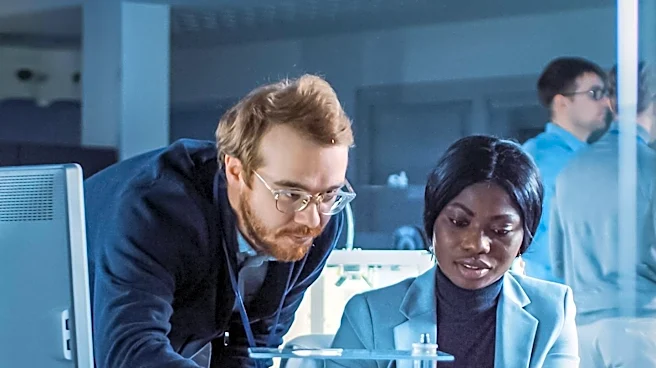
disproportionately affect early-career workers. A new report, 'The End of the Water Cooler: The Hidden Cost of Remote and Hybrid Work on Entry-Level Employees,' highlights that much of professional development for junior employees relies on informal learning, observation, and interaction with experienced colleagues. This tacit learning, which includes receiving feedback, understanding organizational norms, and building professional networks, is often diminished in remote or hybrid settings. A study of Microsoft employees, for instance, found that company-wide collaboration became more siloed with remote work, impacting early-career workers who have not yet established extensive networks. Furthermore, employers are reportedly hiring fewer young workers for remote-capable jobs, and entry-level professional positions are more likely to remain on-site, while flexibility increases with seniority.
Why It's Important?
The implications of reduced informal learning for early-career professionals in hybrid work environments are significant for the U.S. labor market and future workforce development. If younger workers miss out on crucial mentorship and observational learning opportunities, it could lead to a skills gap and hinder their professional growth. This situation creates a potential mismatch where the flexibility of hybrid work is available, but essential learning opportunities are lacking. The long-term consequence could be a less experienced and less connected workforce, impacting innovation and productivity across industries. Companies might find themselves with a talent pipeline that lacks the foundational knowledge and soft skills traditionally acquired through in-person interaction. This also places a greater burden on experienced workers and managers to deliberately provide mentorship and feedback, which previously occurred more organically. The trend of fewer young workers being hired for remote-capable roles could also limit access to diverse talent pools and perpetuate existing inequalities in career advancement.
What's Next?
To mitigate the negative impacts on early-career employees, organizations are encouraged to redesign hybrid work models with a focus on skill development rather than mere attendance. This involves identifying activities that benefit most from in-person interaction and ensuring that junior employees have access to these opportunities. Employers will need to implement more deliberate strategies for mentoring, feedback, and exposure to how work is done, which were once informal processes. Governments funding work-integrated learning programs may also need to emphasize developmental outcomes for new graduates transitioning into the workforce. The responsibility will fall on both employers and experienced workers to actively foster an environment where informal learning and professional judgment can still flourish within a flexible work structure. This could involve structured mentorship programs, dedicated in-office days for collaborative learning, or specific projects designed to facilitate cross-functional interaction.
Beyond the Headlines
The shift in learning dynamics within hybrid work environments raises deeper questions about the nature of professional development and organizational culture. The 'water cooler' effect, often dismissed as casual interaction, is now recognized as a vital component of tacit knowledge transfer and social capital building. The challenge lies in replicating these intangible benefits in a distributed work setting without sacrificing the flexibility that many employees value. This situation also highlights a potential generational divide, as younger workers, particularly Gen Z, express a stronger desire for mentorship and in-person development compared to older generations. The long-term societal impact could include changes in how professional networks are formed, how corporate loyalty is cultivated, and even how innovation occurs, as spontaneous collaboration might decrease. Organizations must consider the ethical implications of potentially disadvantaging a generation of workers by not adequately addressing their developmental needs in the evolving work landscape.