


What's Happening?
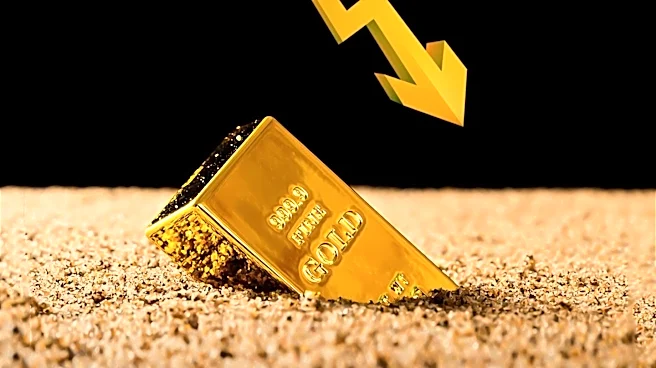
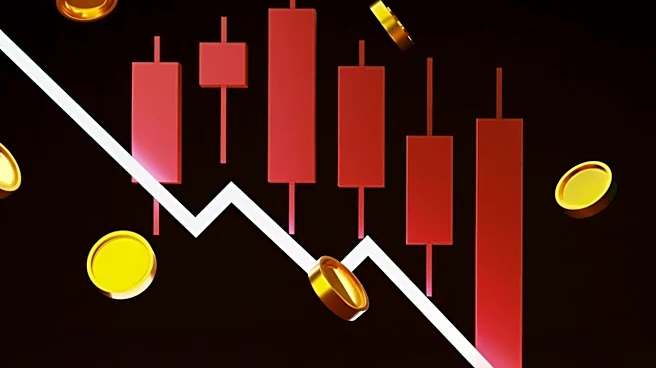
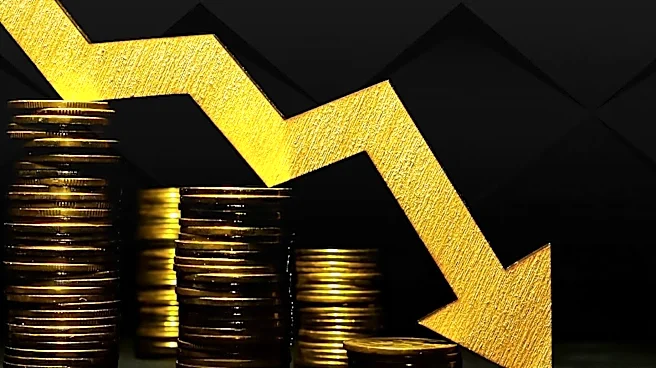
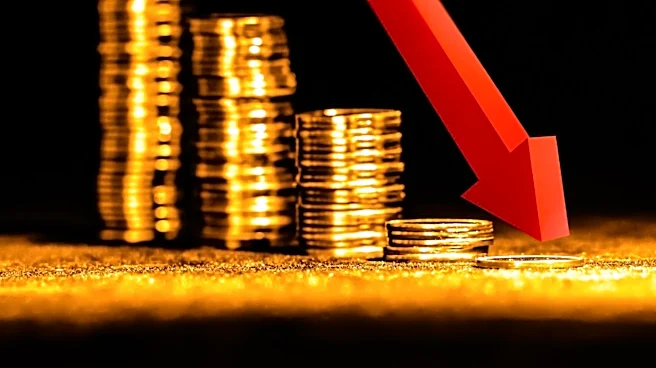
Gold prices have experienced a substantial decline, falling nearly 36% from their record high of $5,594.82 an ounce in January to $3,585.92 an ounce on November 20. This represents an 8% drop during the week, marking its steepest weekly decline in eight
months. The intraday low reached $3,513.54, the weakest level since September 2025. Several factors are contributing to this downturn, including a stronger U.S. dollar, rising Treasury yields, and expectations of further interest rate increases by the Federal Reserve. The sell-off in AI-related stocks has also played a role, with some investors reportedly selling gold to cover losses in other parts of their portfolios. Despite the recent sharp correction, Goldman Sachs maintains a positive long-term outlook, forecasting gold to reach $4,650 by the end of 2027, a slight reduction from their previous $4,800 forecast.
Why It's Important?
The significant drop in gold prices has important implications for U.S. investors and the broader financial market. Gold, often seen as a safe-haven asset, becomes less attractive when interest-bearing assets like Treasury bonds offer higher yields, increasing the opportunity cost of holding bullion. A stronger U.S. dollar also makes gold more expensive for international buyers, potentially reducing demand. The Federal Reserve's anticipated interest rate hikes, with a 99% chance of a 25 basis point increase at the December meeting, further pressure gold prices. While central bank purchases, particularly by China, and global gold ETFs continue to show strong inflows, individual investor demand for physical gold bars and coins has weakened. This divergence suggests a cautious approach from retail investors, while institutional interest remains robust.
What's Next?
The immediate future for gold prices remains uncertain, with potential for further volatility. The Federal Reserve's monetary policy decisions, particularly future interest rate increases, will be a key determinant. Goldman Sachs anticipates another 25 basis point rate increase in December 2026, followed by another in March 2027, with private investor demand expected to recover when the Federal Reserve begins cutting rates in December 2027. Investors are currently weighing whether the current lower prices present a buying opportunity or if further declines are imminent. Continued central bank purchases and a potential revival in private investment demand could support prices over time. However, elevated dollar and bond yields due to further interest rate increases could hinder a swift recovery. Investors are advised to consider their time horizon and the role of gold in their portfolios, potentially spreading purchases across different price levels.
Beyond the Headlines
The recent gold price movements highlight the complex interplay between monetary policy, currency strength, and investor sentiment in the U.S. and global markets. The shift in investor behavior, with institutional inflows into gold ETFs contrasting with a decline in retail demand for physical gold, suggests a nuanced market dynamic. The impact of broader market events, such as the sell-off in AI-related stocks, on traditional safe-haven assets like gold underscores the interconnectedness of financial markets. This situation also brings into focus the ongoing debate about gold's role as an inflation hedge versus an interest-rate-sensitive asset. The long-term outlook, as projected by Goldman Sachs, suggests a potential recovery, but the path to that recovery will likely be influenced by global economic stability and central bank policies.