





What's Happening?
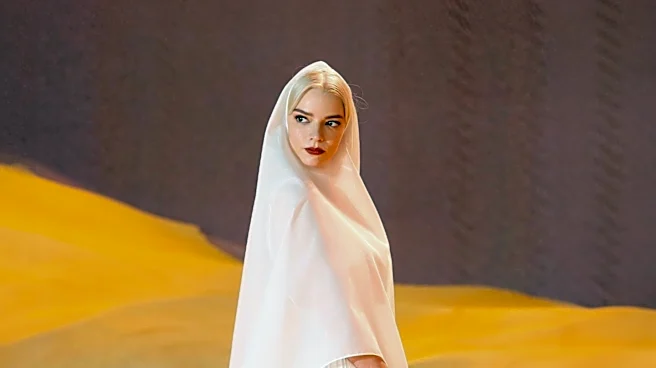
Actress Anya Taylor-Joy, set to appear as Alia Atreides in 'Dune: Parte Tres,' has offered a unique interpretation of the 'Dune' saga, likening it to a 'telenovela' but with the addition of giant sandworms. Utilizing her Latin American background, Taylor-Joy explained
the complex narrative in Spanish, simplifying its core themes for a broader audience. She characterized Paul Atreides as 'the grandson who inherited a lot of responsibility too quickly' and Chani (Zendaya) as 'the woman he loves and also betrays, because, of course, love can never be easy.' Her description of Alia Atreides' role is to 'complicate things a little bit more,' hinting at the character's manipulative nature even from within her mother's womb, Lady Jessica (Rebecca Ferguson). This perspective aims to make the often-serious and intricate world of 'Dune' more accessible.
Why It's Important?
Anya Taylor-Joy's simplified, yet engaging, description of the 'Dune' saga could significantly broaden its appeal, particularly among audiences familiar with the dramatic conventions of telenovelas. By framing the epic science fiction narrative through the lens of family drama, alliances, betrayals, and power struggles, she makes the complex themes more relatable. This approach might attract new viewers who might otherwise be intimidated by the perceived intellectual depth of Frank Herbert's original novels and Denis Villeneuve's film adaptations. For the film industry, this could translate into increased box office success for 'Dune: Parte Tres' by tapping into a wider demographic. Her ability to articulate the story in Spanish also highlights the growing importance of diverse linguistic and cultural approaches in Hollywood's global marketing strategies, potentially boosting international viewership.
What's Next?
Anya Taylor-Joy will officially join the cast of 'Dune: Parte Tres' as Alia Atreides, Paul Atreides' sister, with the film scheduled for release on December 18. Her unique explanation of the saga is likely to be a key talking point in the film's promotional efforts, potentially influencing how the movie is perceived and discussed by both critics and the general public. The marketing team may leverage her 'telenovela with giant worms' analogy to create more accessible and engaging content, especially for Spanish-speaking markets. The success of this interpretive approach could also encourage other actors and filmmakers to find creative ways to demystify complex narratives, making them more palatable for diverse audiences and potentially setting a new trend in film promotion.
Beyond the Headlines
Taylor-Joy's interpretation of 'Dune' as a 'telenovela' subtly challenges the traditional perception of science fiction as a genre solely focused on intellectual or philosophical themes. By emphasizing the human drama, emotional conflicts, and intricate relationships, she underscores the universal appeal of storytelling, regardless of genre. This perspective could encourage a re-evaluation of how complex narratives are presented and consumed, suggesting that even the most epic tales can be understood through relatable human experiences. It also highlights the power of cultural references, as the 'telenovela' format is deeply ingrained in many Latin American cultures, making the story instantly more familiar and engaging for those audiences. This cross-cultural bridge could foster greater appreciation for diverse storytelling traditions within mainstream cinema.