



What's Happening?
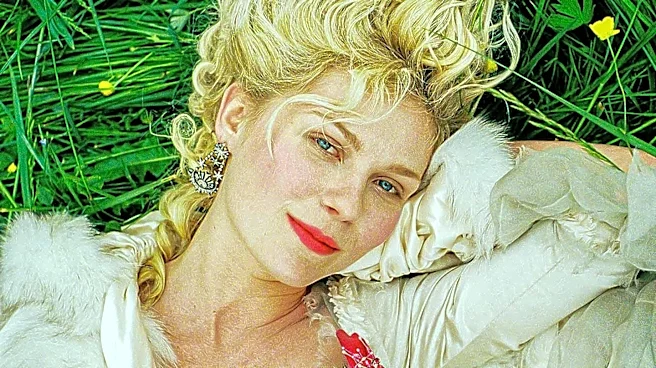
Kirsten Dunst stars as the titular character in Sofia Coppola's 2006 historical drama, 'Marie Antoinette.' The film loosely chronicles the life of the Austrian-born teenager who is sent to France to marry the future King Louis XVI. Dunst's portrayal depicts
Marie Antoinette arriving at Versailles at the age of 14, where she is thrust into a rigid royal court and subjected to constant judgment. The narrative explores her retreat into fashion, food, parties, and an increasingly extravagant lifestyle as political tensions escalate outside the palace. The film is noted for its anachronistic elements, including pastel Manolo Blahniks, champagne, lavish parties, and a soundtrack featuring artists like New Order and The Strokes, offering a modern take on the historical figure.
Why It's Important?
Kirsten Dunst's leading role in 'Marie Antoinette' is significant for several reasons. It showcases her ability to carry a major historical drama, further solidifying her status as a versatile actress. The film itself, directed by Sofia Coppola, is a notable piece of cinema that reinterprets historical narratives through a contemporary lens, challenging traditional period drama conventions. This approach sparked considerable discussion and critical analysis, influencing how historical figures and events can be portrayed on screen. For Dunst, the role allowed her to explore complex themes of isolation, identity, and the pressures of royalty, contributing to her artistic development and critical acclaim. The film's unique aesthetic and narrative style also left a lasting impact on fashion and filmmaking.
What's Next?
Following her role in 'Marie Antoinette,' Kirsten Dunst has continued to take on diverse and challenging roles in both independent and mainstream cinema, further establishing her career. The film's enduring legacy means it continues to be revisited and discussed, particularly for its unique artistic vision and Dunst's performance. For Sofia Coppola, 'Marie Antoinette' reinforced her distinctive directorial style, paving the way for future projects that often explore themes of female experience and isolation. The film's influence on period dramas and historical storytelling is likely to persist, encouraging other filmmakers to experiment with genre conventions and anachronism to create fresh perspectives on the past.
Beyond the Headlines
Beyond its immediate narrative, 'Marie Antoinette' with Kirsten Dunst delves into deeper themes of consumerism, escapism, and the psychological toll of public life. The film's portrayal of Marie Antoinette's lavish lifestyle as a coping mechanism for her isolation and the immense pressures she faced offers a commentary on the human tendency to seek solace in material possessions and superficial pleasures. This resonates with contemporary society's struggles with consumer culture and the impact of public scrutiny. The film also subtly critiques the historical narrative's often one-dimensional portrayal of powerful women, presenting Marie Antoinette not just as a historical figure but as a complex, vulnerable individual navigating an impossible situation. This humanization of a controversial figure encourages a more nuanced understanding of history and the individuals within it.