





What's Happening?
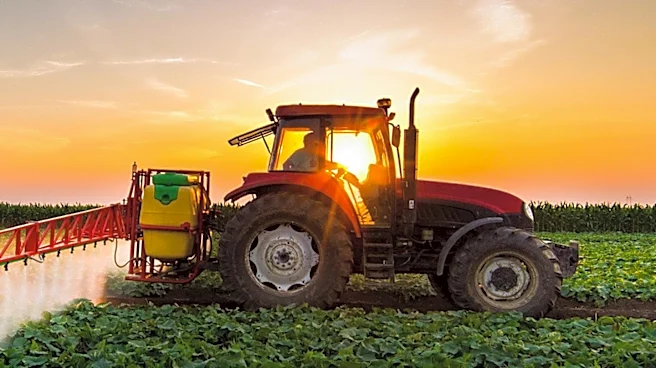
GUSS Automation, a subsidiary of John Deere, plans to equip its next generation of autonomous orchard machines with Ouster’s new Rev8 OS0 lidar. This integration aims to significantly improve navigation and obstacle detection for its Orchard GUSS and Mini
GUSS sprayers, particularly in environments where GPS signals are insufficient due to dense vegetation. The Rev8 OS0 digital lidar offers a 90-degree vertical field of view and generates up to 10.4 million 3D measurement points per second, with a maximum range of 250 meters. A key feature of the Rev8 generation is its native-color lidar, which captures both depth and color within the same sensor architecture, providing spatially and temporally aligned 3D color data. This technology will enable the machines to map tree trunks, crop rows, and ground contours in 3D, enhancing perception under varying light conditions and challenging elements like dust and spray.
Why It's Important?
This technological advancement is crucial for the U.S. agricultural sector, particularly for orchard and vineyard operations. Autonomous sprayers equipped with advanced lidar technology can significantly increase efficiency, reduce labor costs, and improve the precision of chemical application, leading to better crop health and reduced environmental impact. The ability to operate autonomously in GPS-limited environments addresses a major challenge for precision agriculture, expanding the applicability of these machines. For farmers, this means more consistent and effective spraying, potentially leading to higher yields and lower operational expenses. For the broader agricultural industry, it signifies a continued move towards automation and smart farming, enhancing productivity and sustainability in a critical sector of the U.S. economy.
What's Next?
GUSS Automation plans to integrate the Rev8 OS0 digital lidar into its Autonomous Orchard Machine fleet. While no specific timeline for commercial introduction or pricing has been announced, the technology is expected to support autonomous spraying initially. Both GUSS and Ouster anticipate that this lidar-based autonomy approach could be extended to other operations within orchards and vineyards in the future. The current operational model, where one operator monitors up to eight autonomous machines from a laptop, is expected to be further enhanced by the improved sensing capabilities of the new lidar. The focus will be on refining the integration and demonstrating the practical benefits of the advanced perception system in real-world agricultural settings.
Beyond the Headlines
The adoption of native-color lidar in agricultural machinery represents a significant step towards more sophisticated and robust autonomous systems. By combining depth and color data in a single sensor, the Rev8 OS0 simplifies the perception systems for autonomous machines, potentially reducing computational complexity and improving real-time decision-making. This technology could pave the way for more advanced agricultural robotics capable of performing a wider range of tasks with greater precision and autonomy. Beyond spraying, such lidar systems could be used for detailed crop monitoring, yield prediction, automated harvesting, and even individual plant care. This trend towards highly intelligent and autonomous farm equipment could fundamentally transform agricultural practices, making them more data-driven, efficient, and sustainable, while also addressing labor shortages in the agricultural sector.