




What's Happening?
SoftBank Group's stock experienced a significant rebound, jumping 7.32% to 2,894 yen at the close of the regular session in Tokyo on November 26. This surge followed a broader recovery in AI-linked stocks across Asia, which helped SoftBank regain approximately
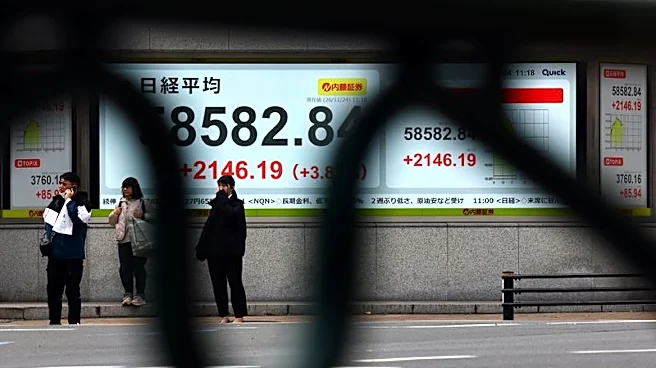
two-fifths of its previous 14.83% plunge. The earlier decline was attributed to a global selloff in AI-related investments, heavily impacting SoftBank due to its substantial stake in OpenAI. Other companies in the sector also saw gains, with memory maker Kioxia surging 12.6% and Tokyo Electron adding 0.6%. The Nikkei 225 also closed 0.9% higher. This market relief mirrored a late recovery on Wall Street, where the Nasdaq Composite managed to trim an intraday drop of 4.6% to close down 0.62%. SoftBank's valuation is particularly sensitive to these market fluctuations because a significant portion of its value is tied to unlisted AI assets, which are repriced based on market sentiment.
Why It's Important?
The volatility in SoftBank Group's stock highlights the broader sensitivity of the market to sentiment surrounding artificial intelligence investments. As a major investor in OpenAI and other private AI holdings, SoftBank's financial performance serves as a bellwether for investor confidence in the AI sector. The rapid swings—a 14.83% drop followed by a 7.32% rebound—underscore the speculative nature of current AI valuations, where changes in sentiment can lead to substantial shifts in market capitalization. This impacts not only SoftBank and its shareholders but also the wider technology investment landscape, as it signals the potential for significant gains or losses based on perceived future growth rather than immediate operating cash flow. The performance of AI-linked stocks, particularly those with substantial private holdings, can influence investment strategies and risk assessments across global markets, including those in the U.S. where many AI companies are based or have significant operations.
What's Next?
The immediate focus for SoftBank and the broader AI market will be on whether the current positive sentiment holds, particularly when U.S. markets reopen for their shortened trading session. The stability of AI stock valuations will be tested, and any further shifts in investor confidence could trigger additional volatility. For SoftBank, the ongoing repricing of its unlisted AI assets will continue to be a key factor influencing its stock performance. The company's strategy regarding its AI investments, including potential future funding rounds or divestitures, will also be closely watched. Furthermore, the performance of other major AI players and the overall economic outlook will play a crucial role in shaping the trajectory of AI-linked stocks. Investors will be looking for signs of sustained growth and profitability in the AI sector to justify current valuations and mitigate future sharp declines.
Beyond the Headlines
The significant fluctuations in SoftBank's stock price reveal a deeper trend in the current investment climate: the increasing influence of speculative capital in emerging technology sectors like AI. The rapid gains and losses, disproportionate to immediate operational cash flow changes, suggest that market valuations are heavily driven by future expectations and investor sentiment rather than traditional financial metrics. This phenomenon raises questions about market stability and the potential for bubbles in high-growth sectors. For the broader economy, such volatility can create both opportunities and risks, attracting significant capital to innovative areas but also exposing investors to substantial downside. It also highlights the challenge for regulators and investors in accurately assessing the value of companies with significant holdings in private, unlisted assets, where transparency and liquidity can be limited. The long-term implications could include a re-evaluation of investment strategies in tech, with a greater emphasis on fundamental value or, conversely, an acceptance of higher risk for potentially higher rewards in transformative technologies.