



What's Happening?
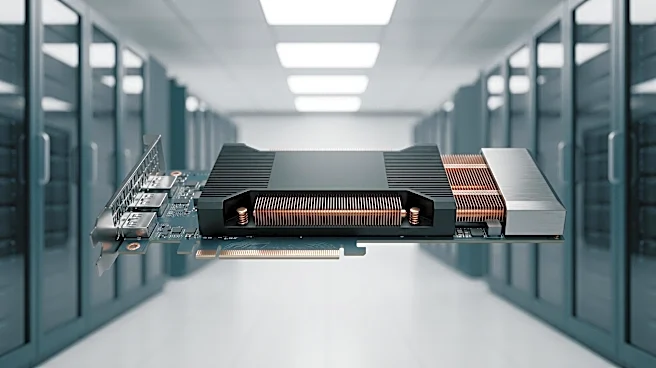
Amazon Web Services (AWS) has rolled out GPU support for its Lambda serverless computing service, enabling event functions to run on EC2 G-series instances. This new capability allows developers to deploy container images with GPU acceleration, triggered
by the same event sources as other Lambda functions. The supported G-series instances include G4dn, G5, G6, G6f, Gr6, and Gr6f, available in commercial regions where both Managed Instances and G-series instances exist. AWS Lambda handles the provisioning, patching, and scaling of these instances, with multiple invocations sharing a single execution environment. The pricing model for this service is based on the EC2 On-Demand rate, plus a 9.75 percent management fee and the standard $0.20 per million requests. This update simplifies the deployment of GPU-accelerated applications by abstracting away the complexities of managing GPU drivers, CUDA versions, and underlying infrastructure.
Why It's Important?
This development is significant for U.S. businesses and developers leveraging AWS, particularly those involved in machine learning inference, data processing, and other computationally intensive tasks. By integrating GPU support directly into Lambda, AWS is making high-performance computing more accessible and easier to manage. Companies can now deploy AI models and other GPU-dependent applications without the overhead of provisioning and maintaining dedicated GPU servers, potentially reducing operational costs and accelerating development cycles. The serverless nature of Lambda, combined with GPU power, allows for automatic scaling to meet demand, which is crucial for applications with fluctuating workloads. This could lead to faster innovation in areas like real-time analytics, computer vision, and natural language processing, benefiting various industries from healthcare to finance by enabling more efficient and scalable AI solutions.
What's Next?
The immediate next steps for AWS users will involve exploring and integrating this new GPU capability into their existing and new Lambda functions. Developers will likely focus on optimizing their container images and model deployments to take full advantage of the GPU acceleration. AWS is expected to continue refining this service, potentially expanding support to more instance types or regions, and enhancing features based on user feedback. The introduction of GPU support for Lambda could also spur the development of new serverless application architectures that were previously impractical due to computational limitations. As more businesses adopt this technology, there may be an increased demand for specialized skills in serverless GPU programming and optimization, influencing training and hiring trends in the tech sector.
Beyond the Headlines
The integration of GPU support into a serverless platform like AWS Lambda represents a broader trend towards democratizing access to advanced computing resources. This move could lower the barrier to entry for smaller businesses and startups to utilize powerful AI and machine learning models, fostering greater innovation across the U.S. tech landscape. Ethically, this increased accessibility to powerful AI tools raises questions about responsible AI development and deployment, particularly concerning bias in models and the potential for misuse. From a competitive standpoint, other cloud providers may follow suit, intensifying the race to offer more comprehensive and user-friendly serverless GPU solutions. This shift could fundamentally alter how AI applications are designed, deployed, and scaled, pushing the industry further into a serverless-first paradigm for high-performance workloads.