






What's Happening?
Carnival Corporation, the world's largest leisure travel company, announced record results for the second quarter, marking its twelfth consecutive quarter of record net yields. Despite facing significant geopolitical challenges and a nearly 30% increase
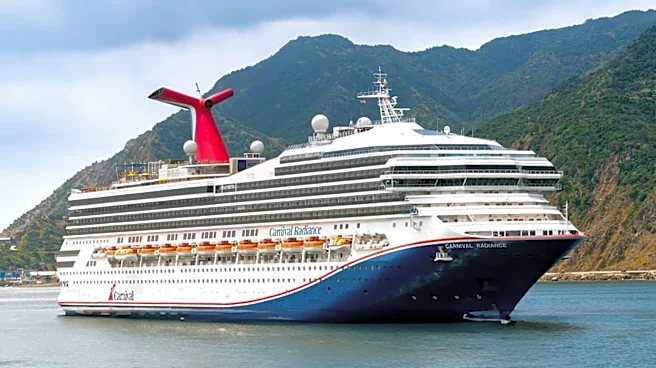
in fuel costs, the company exceeded its March guidance by $100 million. Carnival reported revenues of $6.66 billion, a 5.3% increase year-on-year, which aligned with analysts' expectations. The company also surpassed analysts' EPS estimates, though its EBITDA guidance for the next quarter fell short of projections. Josh Weinstein, Carnival Corporation's Chief Executive Officer, attributed these strong results to robust demand for their diverse portfolio of cruise lines and ongoing progress in business operations and cost efficiency efforts. The company oversees eight distinct brands globally, including Carnival Cruise Line, Holland America Line, Princess Cruises, and Seabourn in North America and Australia, as well as P&O Cruises and Cunard Line in the United Kingdom, AIDA in Germany, and Costa Cruises in Southern Europe.
Why It's Important?
This performance by Carnival Corporation is significant for the U.S. leisure travel industry and the broader consumer discretionary sector. As a major player, Carnival's ability to achieve record net yields and revenue growth despite external pressures like geopolitical instability and rising fuel prices indicates a strong underlying demand for cruise vacations. This resilience suggests that consumers are prioritizing experiences over goods, a trend that benefits travel and vacation providers. However, the market's disappointment, reflected in a 26.7% stock drop since the earnings report, highlights investor sensitivity to future guidance, particularly the missed EBITDA expectations. This indicates that while current demand is strong, concerns about future profitability and the impact of ongoing macroeconomic factors, such as fuel price volatility and potential economic downturns, remain. The consumer discretionary sector is inherently sensitive to economic conditions, and Carnival's results offer a mixed signal about the sector's overall health and future outlook.
What's Next?
Carnival Corporation will likely focus on maintaining its commercial execution and further enhancing cost efficiency to address investor concerns regarding future profitability and EBITDA guidance. The company's strategy will need to navigate the continued impact of geopolitical events and fluctuating fuel costs, which are significant headwinds for the cruise industry. Future reports will be closely watched for signs of sustained demand and improved financial outlooks. The broader consumer discretionary sector will also be under scrutiny, as companies in this segment are highly susceptible to shifts in consumer spending habits and economic conditions. Investors will be looking for clear indications that the post-pandemic travel boom can be sustained and that companies can effectively manage operational costs in an unpredictable global environment. The performance of other travel and vacation providers will also offer insights into the overall trajectory of the sector.
Beyond the Headlines
The strong demand for cruise travel, despite global uncertainties, points to a deeper cultural shift where consumers increasingly value experiences and leisure activities. This trend could have long-term implications for how households allocate their discretionary income, potentially favoring travel and entertainment over material goods. The cruise industry, in particular, faces unique challenges related to environmental sustainability and public health, which are not explicitly detailed in the earnings report but are ongoing considerations. Carnival's emphasis on delivering 'unforgettable happiness' and its commitment to ethical and compliant culture suggest an awareness of broader societal expectations. The company's ability to balance profitability with these evolving consumer values and operational complexities will be crucial for its sustained success and reputation in the global leisure market. The inherent 'hit-driven' nature of the consumer discretionary sector means that companies like Carnival must continuously innovate and adapt to maintain demand and investor confidence.