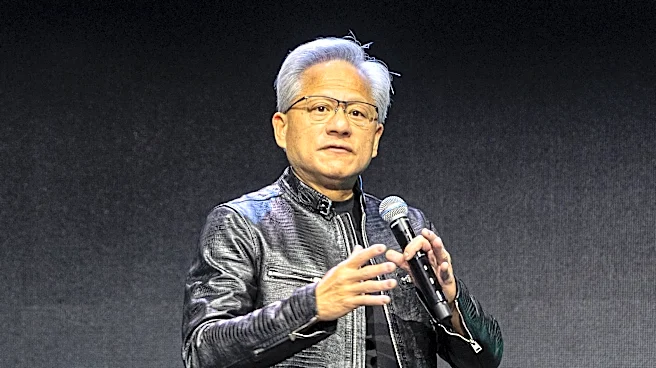







What's Happening?
Nvidia's board of directors has officially rejected former CEO Jensen Huang's offer to return to lead the company. This decision comes as Nvidia faces significant challenges, including a 46% drop in its stock value over six weeks, pushing it to fourth
place among U.S. market capitalizations. The company is also under investigation by the U.S. Securities and Exchange Commission (SEC). Huang, who co-founded Nvidia thirty years ago, had renewed his apologies for past behavior and expressed his belief that he still had much to contribute. Despite his efforts, the board issued a firm refusal. This rejection has led to speculation that Huang might establish a new venture, potentially posing a direct competitive threat to Nvidia by attracting key talent from his former company. The situation highlights a period of internal and external pressure for Nvidia.
Why It's Important?
This development is significant for the U.S. business landscape, particularly within the technology and artificial intelligence sectors. Nvidia's stock decline and the SEC investigation signal potential instability for a major player in the semiconductor industry, which could have ripple effects across the market. The rejection of a co-founder's return, especially one with Huang's industry stature, underscores deep-seated issues within the company's leadership and governance. If Huang does launch a new enterprise, it could intensify competition in the AI and chip manufacturing space, potentially disrupting existing market dynamics and forcing other companies to innovate faster. This scenario could lead to a talent drain from Nvidia, impacting its future research and development capabilities. Investors and stakeholders will be closely watching how Nvidia navigates these challenges and how Huang's next moves might reshape the competitive landscape.
What's Next?
Nvidia's board will need to address the ongoing SEC investigation and work to stabilize the company's stock performance. The leadership will likely focus on reassuring investors and demonstrating a clear path forward without Jensen Huang. Meanwhile, industry observers will be keenly watching for any announcements regarding Huang's potential new venture. If he proceeds with forming a new company, it could quickly become a formidable competitor, given his extensive experience and network within the technology sector. This could trigger a new wave of innovation and competition, particularly in the artificial intelligence domain. The market will also be looking for signs of how Nvidia plans to retain its key employees and maintain its competitive edge in the face of potential poaching by Huang's future endeavors.
Beyond the Headlines
The public rejection of a co-founder's return, coupled with the resurfacing of past controversial behavior, raises broader questions about corporate culture, leadership accountability, and the ethical responsibilities of prominent figures in the tech industry. The incident involving Huang's remarks about Arthur Mensch's accent, though seemingly minor, highlights issues of workplace respect and potential biases that can exist even at the highest levels of corporate interaction. This situation could prompt a re-evaluation of how leaders are perceived and held accountable for their conduct, especially in public forums. Furthermore, the narrative of a powerful founder being ousted and potentially starting a rival company speaks to the intense competition and high stakes within the technology sector, where personal dynamics can significantly influence market trajectories and corporate futures.