








What's Happening?
The U.S. film and television industry is significantly contributing to local economies across various states, including California, New York, Louisiana, New Mexico, Georgia, and Massachusetts. Recent productions like 'The Bride!', 'Highest 2 Lowest',
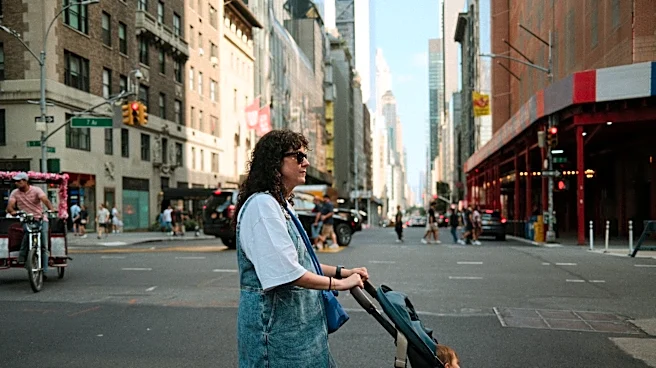
and 'Caught Stealing' have utilized New York City's streetscapes, while shows such as 'Severance' and 'Your Friends and Neighbors' also favor the Empire State. Showrunner Shawn Ryan noted the economic impact of his Netflix series 'Night Agent' in upstate New York, highlighting benefits for crew and supporting businesses. Similarly, composer John Powell employed approximately 80 musicians and 60 choral singers in Los Angeles for the 'Minions & Monsters' soundtrack, emphasizing the importance of local talent. This trend is supported by state-level incentives, with California recently passing a post-production tax credit program to retain editing and visual effects work. The Motion Picture, Television and Entertainment Revitalization Act, a bipartisan proposal for a 20 percent federal production incentive, is currently under consideration in Congress to further encourage domestic filming.
Why It's Important?
The growth of film and television production within the U.S. is crucial for job creation and economic development, extending far beyond direct industry employment. These productions generate work for a wide array of skilled professionals, including costume designers, construction crews, caterers, hotel operators, and musicians. The economic benefits cascade through local communities, supporting small businesses and increasing revenue for services like hotels and restaurants, particularly during off-peak tourist seasons. The proposed federal incentive aims to enhance the U.S.'s competitiveness against other countries that offer similar programs, ensuring that more projects are filmed domestically. This initiative is vital for maintaining a robust national infrastructure for filmmaking and television, fostering a stable environment for workers, and preventing the outflow of production to international locations, which has been a concern for industry professionals.
What's Next?
Congress is expected to continue deliberations on the Motion Picture, Television and Entertainment Revitalization Act, a bipartisan proposal that seeks to establish a 20 percent federal production incentive. If passed, this legislation could significantly increase the number of film and television projects produced within the United States, potentially working in conjunction with existing state-level incentives. Industry stakeholders, including the Motion Picture Association, the Directors Guild of America, labor organizations, and producers, are actively advocating for its passage, emphasizing its potential to create jobs and stimulate local economies nationwide. The outcome of this legislative effort will determine the extent to which the U.S. can attract and retain film and TV productions, influencing future investment in infrastructure, talent development, and supporting businesses across various states.
Beyond the Headlines
The push for federal and state production incentives highlights a broader economic strategy to leverage the creative industries for national growth and job security. Beyond the immediate financial gains, keeping productions within the U.S. fosters cultural preservation and the development of specialized skills that might otherwise diminish. It also reinforces the identity of American cities and regions as vibrant cultural hubs, attracting tourism and further investment. The debate over these incentives touches on the balance between free-market principles and government intervention to protect and promote domestic industries. Furthermore, the success of these programs could set a precedent for other creative sectors, demonstrating how targeted policies can sustain and grow industries that are susceptible to international competition and outsourcing.