




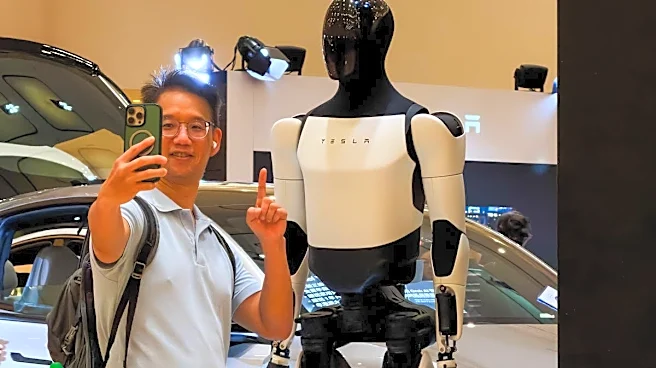
What's Happening?
A new report by IDTechEx, titled 'Batteries for Humanoid Robots 2027-2037: Technologies, Players and Forecasts,' projects a substantial increase in battery demand driven by the emerging humanoid robot market. The report forecasts that the battery demand for humanoid robots
will reach 10.5 GWh by 2037. Humanoid robots, designed to navigate environments built for humans, are gaining traction across various applications, particularly in industrial settings. Batteries are identified as the most suitable power supply due to their high energy density, diverse chemistries, and compact nature. The report also highlights that different operational environments and tasks will necessitate varying battery requirements, with industrial humanoids requiring longer operating times and thus more energy-dense batteries compared to those for commercial or domestic use.
Why It's Important?
This projected surge in battery demand from humanoid robots has significant implications for the U.S. technology and manufacturing sectors. The development and deployment of humanoid robots represent a new frontier in automation, promising economic benefits for manufacturers and potentially revolutionizing various industries. For the U.S., this means a growing market for advanced battery technologies and a need for increased domestic battery production and research. Companies involved in battery manufacturing, materials science, and robotics stand to gain substantially. The demand for specialized batteries will also drive innovation in energy storage solutions, potentially leading to advancements that could benefit other sectors, such as electric vehicles and consumer electronics. Furthermore, the report's emphasis on industrial applications suggests a transformation in manufacturing and logistics, impacting labor markets and operational efficiencies across the country.
What's Next?
The IDTechEx report suggests that the coming years will see intensified research and development in battery technologies tailored for humanoid robots. Manufacturers will likely focus on creating batteries that offer higher energy density, faster charging capabilities, and improved durability to meet the diverse operational demands of these robots. Investment in battery production facilities and supply chains is also anticipated to scale up to meet the projected 10.5 GWh demand by 2037. Additionally, the robotics industry will continue to explore and refine the applications of humanoid robots, particularly in industrial settings, which currently account for 80% of designs. This will involve further integration of robotics into manufacturing processes, logistics, and potentially other sectors, driving the need for a skilled workforce capable of developing, deploying, and maintaining these advanced systems.
Beyond the Headlines
The rise of humanoid robots and their substantial battery requirements points to a deeper societal and technological shift. Beyond the immediate economic impact, the widespread adoption of humanoid robots could redefine human-machine interaction and labor dynamics. Ethical considerations regarding automation, job displacement, and the integration of robots into daily life will become increasingly prominent. The demand for specialized batteries also highlights the critical importance of sustainable sourcing for raw materials and efficient recycling processes to mitigate environmental impact. This technological evolution could also spur advancements in artificial intelligence and sensor technologies, as humanoid robots require sophisticated systems to navigate and interact with their environments. The long-term implications extend to education, public policy, and even the philosophical understanding of intelligence and labor in an increasingly automated world.