





What's Happening?
Amazon (AMZN) shares are trading near $252, with a consensus price target of $326.51, implying significant upside, backed by 59 'Buy' ratings and zero 'Sell' ratings from analysts. This strong positive sentiment persists despite Amazon's third-quarter
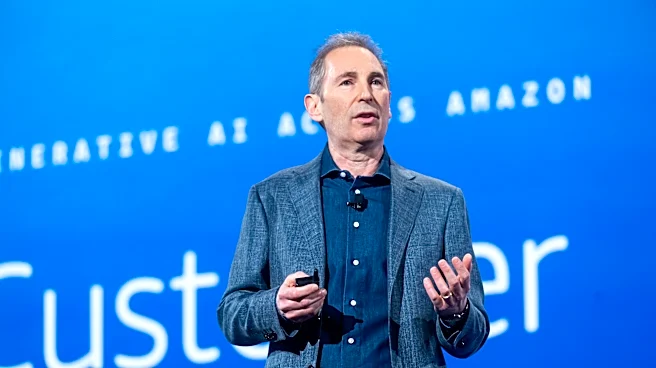
report falling short of expectations, with EPS at $1.89 against a consensus of $1.9579 and revenue of $201.94 billion missing forecasts. Management attributed a portion of the retail growth shortfall to a Prime Day calendar shift. The primary driver for the bullish outlook is Amazon Web Services (AWS), which saw its revenue grow by 39% to $45.98 billion. Amazon CEO Andy Jassy has stated that AWS is projected to grow 'north of 40%' in both 2027 and 2028, supported by a substantial backlog of $578 billion. The company's consolidated operating margin reached a historical high of 13.9%. However, Amazon's significant capital expenditure plan, estimated at $220 billion for 2026, has resulted in a trailing 12-month free cash flow outflow of $42.4 billion, which analysts identify as a key risk.
Why It's Important?
The continued strong 'Buy' ratings for Amazon, despite a recent earnings miss and substantial capital outflow, underscore the market's confidence in the long-term growth potential of AWS. AWS's robust performance and projected future growth are seen as critical to Amazon's overall profitability and valuation, effectively offsetting concerns about the retail segment and high capital expenditures. This situation highlights the increasing importance of cloud computing as a core business driver for major tech companies. For investors, the focus remains on AWS's ability to meet or exceed its ambitious growth targets, as this will largely dictate Amazon's future stock performance. The high capital expenditure, while a short-term drag on free cash flow, is viewed by bulls as an investment necessary to sustain AWS's competitive edge and future expansion, particularly in emerging areas like AI with products like Bedrock token volume seeing significant increases.
What's Next?
Investors will closely monitor Amazon's upcoming financial reports, particularly focusing on AWS's growth trajectory and the impact of the company's substantial capital expenditures on free cash flow. The market will be looking for confirmation that AWS can indeed sustain growth 'north of 40%' in the coming years, as projected by CEO Andy Jassy. The planned sale of Trainium chips to outside customers in late 2027 could also provide a new revenue stream and further solidify AWS's position in the AI infrastructure market. Any signs of a slowdown in AWS growth or an inability to manage capital spending effectively could lead to increased scrutiny and potentially impact the stock's strong analyst ratings. Conversely, continued strong performance from AWS and efficient capital deployment would likely reinforce investor confidence and support the bullish outlook.
Beyond the Headlines
The dynamic between Amazon's high capital expenditure and its reliance on AWS for profitability reflects a broader trend in the tech industry where massive investments in infrastructure are required to maintain leadership in cloud and AI. This strategy, while promising long-term gains, also carries significant financial risk, as evidenced by the negative free cash flow. The market's willingness to overlook short-term financial metrics for long-term growth potential in AWS also highlights the perceived value of cloud dominance. Furthermore, the increasing integration of AI capabilities, such as Bedrock token volume, into AWS signifies the evolving nature of cloud services, moving beyond basic infrastructure to offer advanced, specialized solutions. This shift could reshape the competitive landscape, favoring providers that can innovate rapidly in AI and other cutting-edge technologies.