





What's Happening?
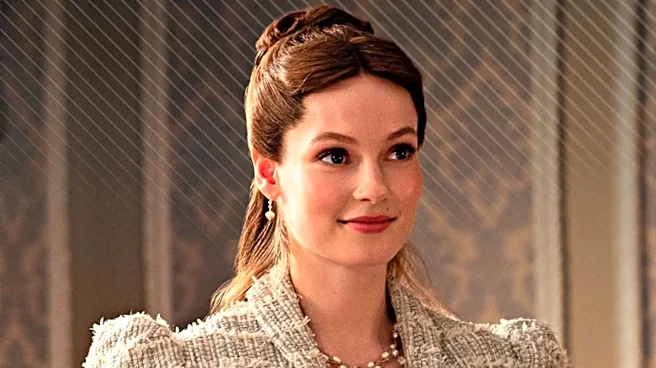
Canadian actress Amy Forsyth is featured in HBO's historical drama series 'The Gilded Age' in the role of Carrie Astor. Carrie Astor is depicted as the youngest daughter of Mrs. Astor, a prominent figure in late 19th-century New York high society. Following
in her mother's footsteps, Carrie Astor became a notable socialite and party hostess of her era, earning the press label 'the beauty of the house of Astor.' Her marriage to Tennessee-born banker Marshall Orme Wilson caused some controversy, as her mother considered his family to be 'nouveau riche.' Despite this, the marriage proceeded, and the couple resided in a lavish mansion on East 64th Street. The series, created by Julian Fellowes, brings to life the social dynamics and tensions between established old money families and ambitious new money families in New York during a period of significant social and technological change.
Why It's Important?
Amy Forsyth's portrayal of Carrie Astor contributes to the historical authenticity and dramatic narrative of 'The Gilded Age.' The character of Carrie Astor represents a significant aspect of the social elite in late 19th-century New York, illustrating the generational shifts and evolving social norms within the upper echelons of society. Her story, including the controversial marriage to Marshall Orme Wilson, highlights the rigid social structures and the challenges faced by individuals navigating these expectations. The series itself is important for its depiction of a pivotal era in American history, showcasing the interplay between wealth, status, and societal influence. The inclusion of real-life historical figures like Carrie Astor, alongside fictionalized narratives, provides viewers with insights into the cultural and social landscape of the Gilded Age, making history accessible and engaging through dramatic storytelling.
What's Next?
As 'The Gilded Age' continues, viewers can anticipate further exploration of Carrie Astor's character arc and her role within the social circles of New York. Her interactions with other historical and fictional characters will likely continue to shed light on the complexities of the era's high society. The series is expected to delve deeper into the personal and public lives of its characters, reflecting the societal pressures and expectations of the time. Future episodes may explore the implications of Carrie's marriage, her growing influence as a socialite, and how she navigates the evolving landscape of New York's elite. The ongoing narrative will likely continue to blend historical facts with dramatic interpretations, offering a rich tapestry of the Gilded Age's social and cultural dynamics.
Beyond the Headlines
The character of Carrie Astor, as portrayed by Amy Forsyth, offers a lens into the broader themes of class, tradition, and social mobility during the Gilded Age. Her story underscores the tension between inherited status and newly acquired wealth, a central conflict of the era. The controversy surrounding her marriage to Marshall Orme Wilson reflects the deep-seated prejudices and exclusionary practices within old-money society against those deemed 'nouveau riche.' This dynamic highlights the societal gatekeeping prevalent at the time and the challenges individuals faced in transcending established social hierarchies. Furthermore, Carrie Astor's eventual rise as a prominent socialite demonstrates the evolving nature of influence and power within elite circles, where personal charisma and strategic alliances could reshape social standing. The series, through such characters, implicitly critiques the superficiality and rigidness of the era's social structures while also celebrating the resilience and ambition of those who navigated them.