





What's Happening?
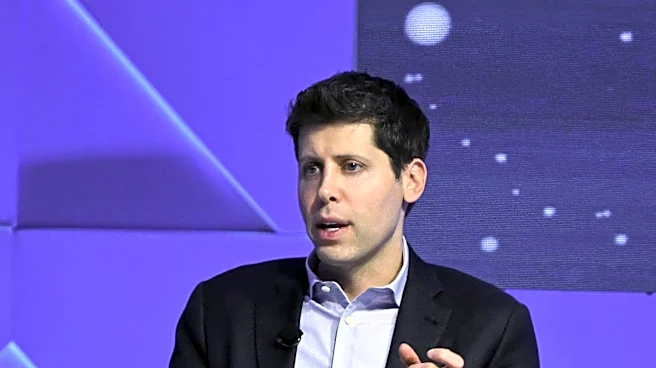
Sam Altman, CEO of OpenAI, has stated that the company will prioritize its mission over its share price if and when it goes public. In an interview with Vanity Fair, Altman indicated that OpenAI is not in a rush to go public but affirmed that a non-profit
entity would continue to govern the company. He emphasized that investors would be reminded that the mission comes first, even if it means the stock price experiences significant volatility or falls considerably. Altman believes that the company's mission and strong financial returns are compatible, but in cases of tension, the mission will take precedence. He also confirmed that he holds no direct equity in OpenAI, describing his minimal exposure through an old Y Combinator investment as a "mistake" that has ironically eroded trust.
Why It's Important?
This declaration by Sam Altman is highly significant for the U.S. business and technology sectors, particularly for the burgeoning artificial intelligence industry. It signals a potential paradigm shift in corporate governance for high-growth tech companies, suggesting a model where social impact and mission-driven objectives could explicitly outweigh traditional shareholder value maximization. This approach could attract a different type of investor, those more aligned with long-term societal goals rather than short-term financial gains. It also sets a precedent for how other AI companies might structure their future public offerings, potentially influencing the broader market's valuation metrics and investment strategies. For OpenAI, this commitment could help maintain its unique identity and focus on safe and beneficial AI development, distinguishing it from other publicly traded tech giants primarily driven by quarterly earnings. However, it also introduces uncertainty for potential investors regarding stock performance.
What's Next?
While Altman has ruled out a public listing for OpenAI in 2026, his statements lay the groundwork for how the company might approach an IPO in the future. Potential investors will need to carefully consider this mission-first philosophy, which could lead to a unique investor base more tolerant of stock volatility. The company will likely continue to articulate how its mission translates into sustainable business practices and long-term value creation. This stance could also influence regulatory discussions around public benefit corporations and alternative corporate structures that allow for mission-driven objectives alongside profit. The tech industry will be watching closely to see if OpenAI can successfully navigate a public market with this unconventional commitment, potentially inspiring other companies to adopt similar models.
Beyond the Headlines
Altman's personal decision to hold no direct equity in OpenAI, which he now views as a "trust-destroying thing," highlights a deeper tension between personal wealth accumulation and perceived altruism in the tech world. This situation raises questions about the motivations of tech leaders and the public's perception of their commitment to societal good versus personal gain. The idea of a non-profit governing a public company also challenges conventional corporate structures, potentially paving the way for new hybrid models that blend capitalist enterprise with philanthropic or public-interest objectives. This could lead to a re-evaluation of what constitutes a successful and ethical business in the 21st century, particularly in sectors with profound societal impact like AI. The long-term cultural and ethical implications could be a shift towards greater emphasis on corporate social responsibility and a redefinition of "value" beyond mere financial metrics.