





What's Happening?
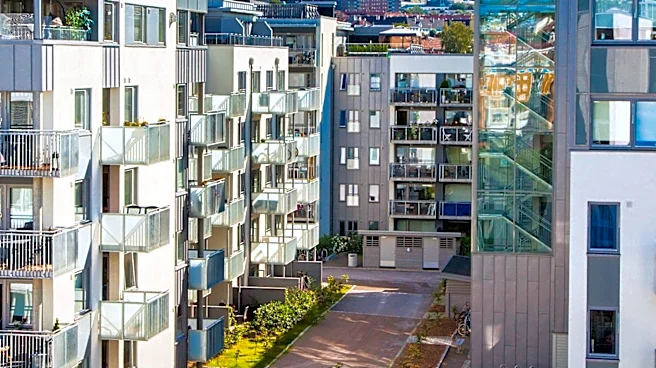
The Verra residential complex, designed by MVRDV, has officially opened on Boston's new Enterprise Research Campus (ERC) in the Allston neighborhood. This complex provides 343 apartments and is integrated into a vibrant district that includes laboratories,
conference facilities, and a hotel. Verra's ground floor features locally owned shops, cafés, and restaurants, designed to connect with Allstonway, the new public park central to the ERC. The project is a collaboration between the Harvard Allston Land Company and Tishman Speyer, aiming to foster interaction between academia, industry, and the local community. The buildings, an eight-story mid-rise and a 17-story tower, feature green façades with varied sections, recalling historic Boston architecture. Verra targets LEED-Gold sustainability certification and Fitwel certification, emphasizing high energy and water efficiency.
Why It's Important?
The opening of the Verra complex signifies a significant step in the development of Boston's Enterprise Research Campus, a major initiative designed to strengthen the ties between Harvard University and the innovation sector. This project contributes to Boston's housing supply with 343 new units, addressing ongoing demand in the region. Its focus on integrating residential, commercial, and public spaces aims to create a dynamic, walkable community that fosters collaboration and innovation. The emphasis on LEED-Gold and Fitwel certifications highlights a growing trend in sustainable urban development, setting a standard for future projects in the area. By bringing together scientists, students, entrepreneurs, and residents, the ERC, with Verra as a key component, is poised to become a hub for scientific advancement and community engagement, impacting both the local economy and the broader innovation ecosystem.
What's Next?
The completion of Verra marks a significant milestone for the Enterprise Research Campus, but it is part of a larger, ongoing development. Future phases of the ERC will likely see the continued expansion of laboratory, office, and educational facilities, further solidifying its role as a nexus for research and innovation. The success of Verra in integrating residents with the broader campus and local community will serve as a model for subsequent residential or mixed-use developments within the ERC. The public spaces, such as Allstonway, will continue to evolve as more residents and workers populate the campus, fostering a vibrant urban environment. The project's commitment to sustainability will also likely influence future construction standards in the region, pushing for more environmentally conscious development practices.
Beyond the Headlines
The Verra complex and the broader Enterprise Research Campus represent a strategic effort to bridge the traditional divide between academic institutions and urban development. This project is not just about constructing buildings but about creating an ecosystem where intellectual capital can translate into tangible innovation and community benefit. The architectural design, which subtly references historic Boston while embracing modern sustainability, reflects a thoughtful approach to urban integration. Furthermore, the inclusion of locally owned businesses on the ground floor aims to prevent the campus from becoming an isolated academic enclave, instead fostering genuine community interaction and economic opportunity for local entrepreneurs. This model of integrated development could serve as a blueprint for other university-led urban renewal projects across the U.S., demonstrating how academic institutions can drive economic growth while enhancing local community life and promoting sustainable practices.