


What's Happening?
Chinese physical AI startup Simplexity Robotics has secured $100 million in a funding round spearheaded by Jack Ma-backed Ant Group Co. This investment values Simplexity at $1.6 billion in its pre-Series A funding round. Existing investors, including
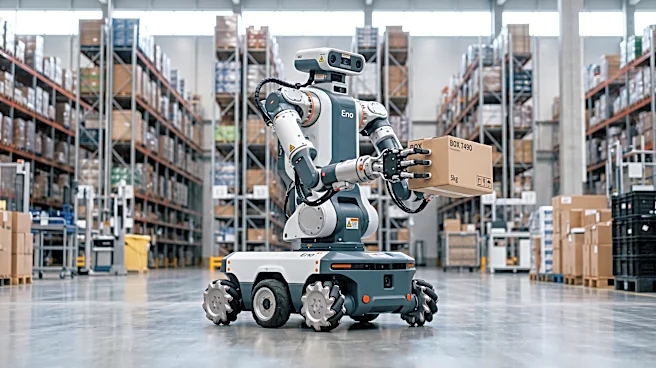
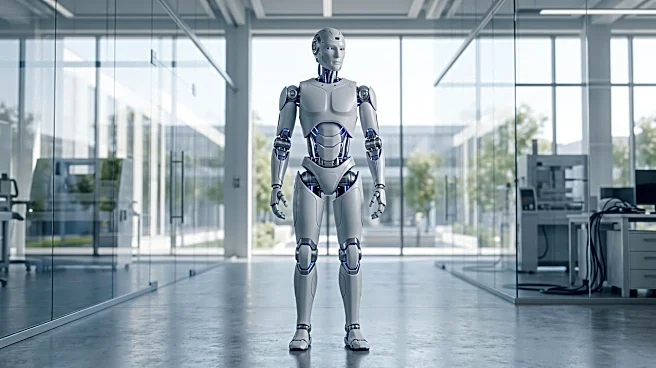
Tencent Holdings Ltd., HSG, and Lanchi Ventures, also participated. Simplexity Robotics, founded by former Li Auto executives Wang Kai, Jia Peng, and Wang Jiajia, achieved a valuation exceeding $1 billion within months of its establishment. The company recently unveiled its second humanoid robot, the iX, capable of tasks such as preparing and serving beverages, fetching items, and conducting guided tours. Simplexity's customers include Korean robotics startup Rlwrld Inc., Tsinghua University, and forklift maker Hangcha Group Co., with whom it has launched a warehouse sorting line. Ant Group's investment further expands its robotics portfolio, which already includes stakes in Unitree, Astribot, and Zeroth.
Why It's Important?
This significant investment highlights the escalating competition and rapid growth within China's humanoid robotics industry. China has taken an early lead over American rivals, accounting for 97% of humanoid machines shipped in the first three quarters of 2026. This dominance is fueled by government policy support and a robust local supply chain. The country's economic planning body has, however, cautioned about a potential bubble risk in the sector. Simplexity's focus on developing robots for tasks that people are increasingly unwilling to do, such as operating CNC machines in noisy and dusty environments, addresses a critical labor shortage in China. The company's ability to design both hardware and a full in-house software stack, from AI world models to real-world data training, positions it as a key player in the embodied AI space. The competitive Chinese market, according to Wang Kai, serves as a proving ground, suggesting that success there could lead to greater profitability in global markets.
What's Next?
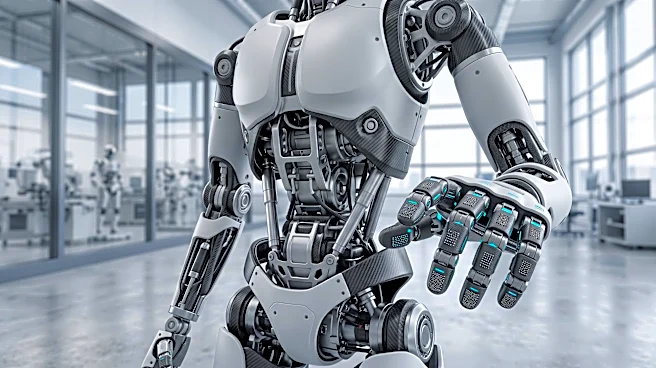
Simplexity Robotics plans to continue developing and deploying its humanoid robots for various commercial applications, particularly in manufacturing, logistics, retail, and pharmaceutical packaging. The company is also building China's first modular humanoid arm, allowing for flexible configurations to suit specific tasks. With rising labor costs and a shrinking productive workforce in China, the demand for robotic solutions is expected to grow, making Simplexity's offerings increasingly relevant. The company's ambition to create a 'breakout app of embodied AI' suggests a continued push for innovation and market leadership. The ongoing government support and deep supply chain in China will likely continue to foster a competitive environment, potentially leading to further advancements and wider adoption of humanoid robotics.
Beyond the Headlines
The rapid advancement of humanoid robotics in China, exemplified by Simplexity Robotics' success, raises broader questions about the future of labor and automation globally. As robots take on tasks deemed undesirable or dangerous, there will be significant societal implications, including potential shifts in employment landscapes and the need for workforce retraining. The ethical considerations surrounding AI and robotics, particularly in human-robot interaction and decision-making, will become increasingly prominent. Furthermore, the competitive dynamics between Chinese and American robotics firms could lead to a technological arms race, influencing global standards and intellectual property. The development of sophisticated, adaptable robots like Simplexity's iX could also pave the way for new service industries and redefine the capabilities of automated systems in everyday life.