
What's Happening?
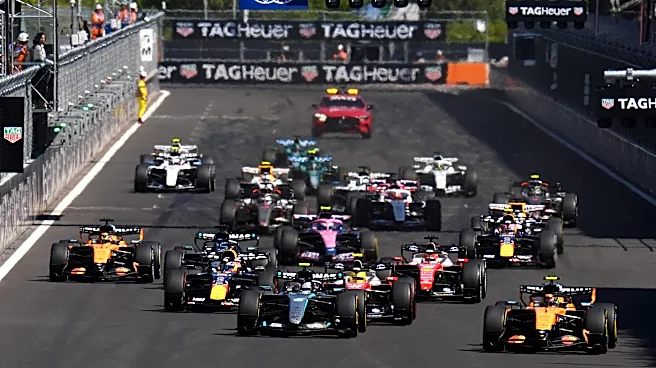
Oscar Piastri concluded the Spanish Grand Prix in eighth position, a result significantly impacted by two contacts with George Russell on the opening lap. These incidents caused damage to Piastri's front
wing, specifically a broken end-plate, which reduced his car's downforce. Despite the damage, McLaren opted not to fully repair the front wing during his pit stop, leading to frustration expressed by Piastri over team radio. His race was further complicated by heavy traffic following his final pit stop, which saw him temporarily drop to 11th place. Piastri managed to recover some positions, ultimately finishing eighth, but described the race as 'painful' and 'difficult' due to the compromised car performance from the first lap. This performance contrasts sharply with his teammate Lando Norris, who showed the McLaren car had the pace to contend for a win.
Why It's Important?
Piastri's performance in the Spanish Grand Prix highlights the critical role of early race incidents and strategic decisions in Formula 1. The damage sustained on the first lap significantly hampered his ability to compete, underscoring how minor collisions can have a cascading effect on a driver's entire race. The team's decision not to fully repair the front wing, despite Piastri's frustration, points to the complex trade-offs teams face between track position and optimal car performance. This event also draws attention to the competitive dynamics within McLaren, as Piastri's struggles contrast with Norris's strong showing, potentially influencing team strategies and driver development in the future. For Piastri, consistently strong performances are crucial for his standing within the team and the broader F1 grid, especially given the high expectations placed on young talents.
What's Next?
Piastri will be looking to rebound in the upcoming Azerbaijan Grand Prix, an event where he experienced an early retirement last year. The McLaren team will likely analyze the data from the Spanish Grand Prix to understand the impact of the front wing damage and review their pit stop strategy. Piastri himself expressed a desire to learn from the race to better understand the car and his driving style for the remainder of the season. The focus will be on improving his qualifying performance to avoid starting in the midfield, which is often fraught with risk on narrow street circuits. His ability to perform strongly in Baku will be key to regaining momentum and demonstrating his potential, especially as the season progresses and championship points become increasingly vital.
Beyond the Headlines
The incident and its aftermath touch upon the psychological aspect of racing, as Piastri's visible frustration on team radio indicates the immense pressure drivers face. The decision-making process during a race, particularly regarding car repairs versus maintaining track position, reveals the intricate balance between engineering and strategy in Formula 1. Furthermore, the contrast between Piastri's and Norris's results in the same car could spark discussions about driver adaptation, car setup preferences, and the inherent variability in performance even within a top team. This situation also subtly highlights the role of luck and unforeseen circumstances, such as virtual safety car timings and opening lap skirmishes, in determining race outcomes, often overshadowing pure pace or skill.