









What's Happening?
BlackRock, JPMorgan, and Visa are significantly advancing the integration of digital assets into mainstream finance, bolstering the case for crypto growth, according to Grayscale's head of research, Zach Pandl. BlackRock has expanded access to blockchain-based
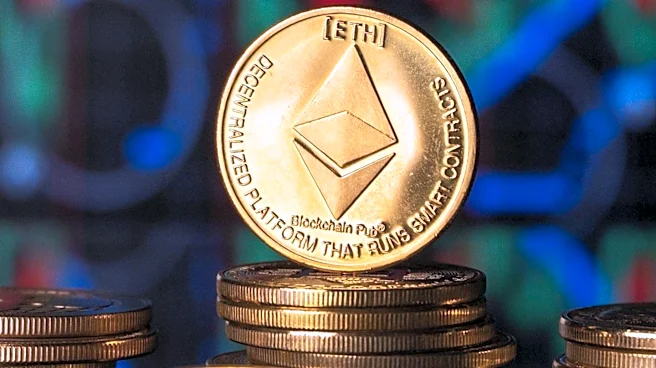
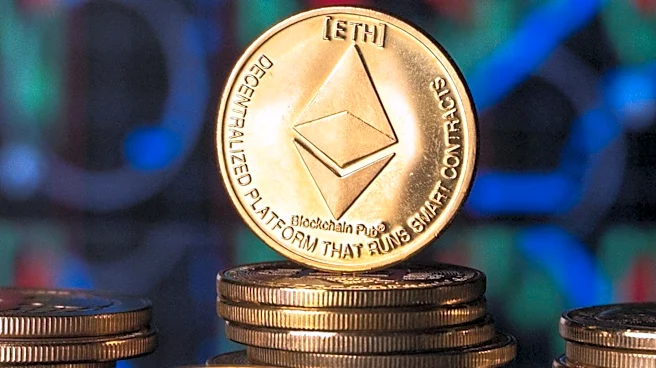
versions of cash-management strategies for European investors, utilizing JPMorgan’s Kinexys blockchain business on Ethereum. BlackRock also introduced two tokenized money market products in August, extending its digital market offerings. JPMorgan Chase’s asset management business further expanded tokenized money market funds to Solana in October. Visa has reported a substantial increase in its annualized stablecoin settlement volume, surpassing $25 billion, a tenfold increase year-over-year, and now supports 10 blockchains. These developments indicate a deepening embedment of public blockchain technology within the traditional financial system, driven by institutional adoption.
Why It's Important?
The active participation of financial giants like BlackRock, JPMorgan, and Visa in the digital asset space is a critical validation for the cryptocurrency market. Their initiatives are moving crypto beyond speculative trading into practical, institutional-grade financial applications. BlackRock and JPMorgan's expansion of tokenized funds signifies a shift towards more efficient and transparent asset management, potentially revolutionizing how traditional investments are handled. Visa's massive increase in stablecoin settlement volume highlights the growing utility of digital currencies for payments and cross-border transactions, offering faster and more cost-effective alternatives to traditional banking rails. This institutional embrace is crucial for mainstream adoption, providing regulatory clarity, enhanced security, and increased liquidity, which are essential for crypto to become a fundamental part of the global financial system.
What's Next?
The continued integration of digital assets by these major players suggests a future where blockchain technology underpins a significant portion of financial transactions and investment products. We can anticipate further expansion of tokenized funds across various asset classes and geographies. The growth in stablecoin usage for settlements will likely drive more payment networks and financial institutions to adopt similar blockchain-based solutions. This institutional push will also likely accelerate regulatory developments globally, as governments and financial bodies work to establish clear frameworks for digital assets. The increased institutional involvement is expected to bring greater stability and maturity to the crypto market, potentially attracting even more traditional investors and fostering further innovation in decentralized finance and blockchain applications.
Beyond the Headlines
The actions of BlackRock, JPMorgan, and Visa represent a profound shift in the financial paradigm, moving beyond the initial skepticism surrounding cryptocurrencies. This institutional embrace signifies a recognition of blockchain's inherent advantages in efficiency, transparency, and programmability. The tokenization of traditional assets and the use of stablecoins for settlement are not just incremental improvements but foundational changes that could redefine financial infrastructure. This trend also highlights the increasing convergence of traditional finance (TradFi) and decentralized finance (DeFi), where the best aspects of both worlds are being leveraged. The long-term implications include a more interconnected, efficient, and potentially inclusive global financial system, where digital assets play a central role in everything from investment management to cross-border payments, fundamentally altering how value is exchanged and stored.