





What's Happening?
NVIDIA has unveiled its latest technologies for the holiday season, focusing on the GeForce RTX 50 Series laptops and desktops, and NVIDIA RTX Spark PCs. These new products are designed to enhance gaming, creative projects, and AI development. The GeForce RTX 50 Series,
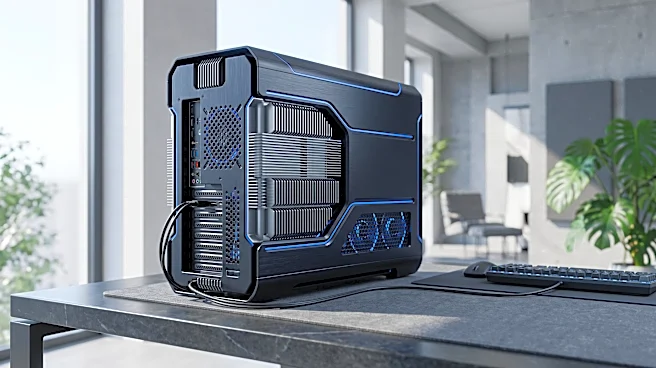
built on the NVIDIA Blackwell architecture, features fifth-generation Tensor Cores and fourth-generation RT Cores, providing AI-enhanced graphics, detailed ray-traced worlds, and high frame-per-second gaming. NVIDIA RTX Spark PCs integrate RTX graphics with NVIDIA’s full-stack AI platform on a single superchip, offering accelerated creation, immersive gaming, and powerful local AI capabilities in slim laptops and compact desktops. Additionally, NVIDIA is promoting its DLSS 5 technology for improved performance and image quality in games, NVIDIA Reflex and G-SYNC for responsive gameplay, and the GeForce NOW cloud gaming service for broader accessibility. For creators, NVIDIA Studio tools and technologies offer AI acceleration for video editing, 3D design, and livestreaming. The company also highlights the NVIDIA Jetson edge AI platform for building robots and autonomous machines, providing hardware and software for projects involving computer vision, generative AI, and multimodal robot control.
Why It's Important?
The introduction of NVIDIA's new GeForce RTX 50 Series and RTX Spark PCs signifies a significant advancement in consumer-grade computing, particularly for gaming and content creation. These technologies aim to push the boundaries of visual fidelity and processing power, making high-end graphics and AI capabilities more accessible to a wider audience. For the gaming industry, the enhanced graphics and performance offered by the RTX 50 Series and DLSS 5 technology could lead to more immersive and realistic gaming experiences, potentially driving demand for new hardware and software. For creators, the AI acceleration in NVIDIA Studio tools can streamline complex workflows in video editing and 3D design, fostering innovation and efficiency. The emphasis on local AI processing with RTX Spark PCs also suggests a trend towards more powerful on-device AI applications, reducing reliance on cloud computing for certain tasks. Furthermore, the NVIDIA Jetson platform's focus on robotics and AI development could inspire a new generation of innovators and hobbyists, contributing to advancements in AI and automation.
What's Next?
Looking ahead, the widespread adoption of NVIDIA's new RTX technologies is expected to influence the development of future games and creative applications. Game developers will likely leverage the enhanced capabilities of the RTX 50 Series and DLSS 5 to create more visually stunning and performance-intensive titles. Similarly, software developers in creative fields may integrate NVIDIA Studio's AI acceleration features to offer more powerful and efficient tools for artists and designers. The push for local AI processing in RTX Spark PCs could lead to a proliferation of AI-powered applications that run directly on user devices, offering greater privacy and responsiveness. In the robotics sector, the NVIDIA Jetson platform is poised to continue fostering innovation, with more complex and intelligent robots being developed by hobbyists and professionals alike. The holiday season sales will provide an initial indicator of consumer interest and market adoption for these new technologies, shaping NVIDIA's future product development and market strategies.
Beyond the Headlines
Beyond the immediate impact on gaming and creative industries, NVIDIA's latest offerings highlight a broader technological shift towards integrating advanced AI capabilities directly into consumer hardware. The emphasis on AI-enhanced graphics and local AI processing suggests a future where AI is not just a backend service but an integral part of everyday computing experiences. This could lead to more personalized and intelligent interactions with devices, from dynamic game environments that adapt to player actions to creative software that can anticipate and assist with user intentions. The accessibility of platforms like NVIDIA Jetson also democratizes AI development, potentially leading to unexpected innovations from a diverse range of creators. However, this rapid advancement also raises questions about the increasing power consumption of high-end hardware and the potential for a growing digital divide between those who can afford the latest technology and those who cannot. The long-term implications include a potential reshaping of digital content creation, entertainment, and even the way we interact with intelligent machines in our daily lives.