

What's Happening?
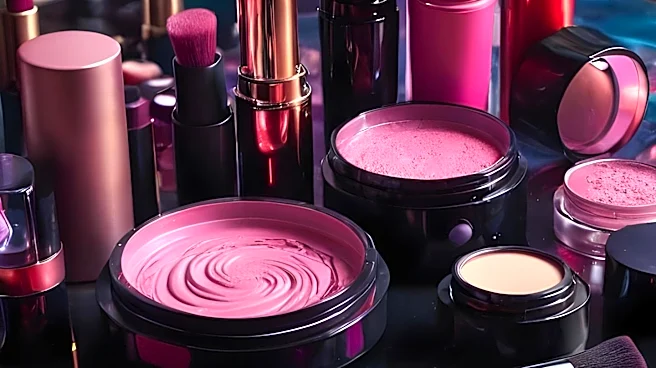
The launch of Atlas Atelier in the United States this fall signifies a growing trend towards more ostentatious and visible makeup, moving away from the long-standing convention that successful cosmetic intervention should be undetectable. Founded by Michelle
Duncan, Atlas Atelier deliberately excludes foundation from its range, focusing instead on color cosmetics designed to be seen. This development aligns with a broader cultural shift, observed since Pamela Anderson's makeup-free appearance at Paris Fashion Week, where artifice itself is becoming desirable. Research by marketing professors Rosanna K. Smith, Linyun W. Yang, and Adriana Samper highlights the 'double bind of beauty work,' where women are socially obligated to improve their appearance but penalized for doing so too obviously. The new aesthetic, embraced by brands like Atlas Atelier, suggests a departure from the 'effortless beauty' ideal, where visible effort in makeup is no longer seen as a negative.
Why It's Important?
This shift in beauty standards has significant implications for the cosmetics industry, marketing strategies, and societal perceptions of women's appearance. For the industry, it opens new avenues for product development focused on bold colors and visible textures, potentially boosting sales in categories like eyeshadows, lipsticks, and eyeliners. For consumers, it offers a sense of liberation from the pressure to appear 'naturally beautiful,' allowing for greater self-expression through makeup. This trend challenges the 'moral superiority' often conferred upon women whose beauty seems unassisted, as noted by philosopher Heather Widdows. It suggests a re-evaluation of what constitutes 'acceptable fake' and could lead to a more honest discourse about the effort involved in beauty routines. The move away from undetectable makeup also reflects a broader cultural embrace of authenticity and individuality, where visible artifice is celebrated rather than concealed.
What's Next?
The cosmetics market is likely to see an increase in products catering to this demand for visible and expressive makeup. Brands may pivot their marketing campaigns to emphasize creativity and self-expression rather than natural enhancement. This trend could also influence fashion and media, with more prominent and artistic makeup looks appearing on runways, in magazines, and on social media. However, there's a potential for a new 'social obligation' to emerge, where dramatic makeup becomes the new norm, as suggested by Smith regarding Botox. The ongoing societal negotiation of what is 'acceptable fake' will continue, potentially leading to new forms of pressure on women to conform to evolving beauty ideals. The long-term impact will depend on whether this shift truly liberates women from appearance-related pressures or simply replaces one set of expectations with another.
Beyond the Headlines
The evolving perception of makeup, from a tool for subtle enhancement to a medium for overt self-expression, reflects deeper cultural conversations about gender, authenticity, and societal expectations. The 'double bind' of beauty work highlights the inherent contradictions women face in navigating appearance standards. By embracing visible makeup, women may be reclaiming agency over their bodies and challenging the patriarchal gaze that often dictates what is considered 'beautiful.' This movement could foster a more inclusive beauty landscape, where diverse forms of expression are celebrated. However, it also raises questions about whether this shift genuinely liberates women from the burden of appearance or merely redefines the parameters of that burden. The cultural significance of makeup extends beyond aesthetics, touching upon issues of identity, power, and the ongoing struggle for women to define beauty on their own terms.