







What's Happening?
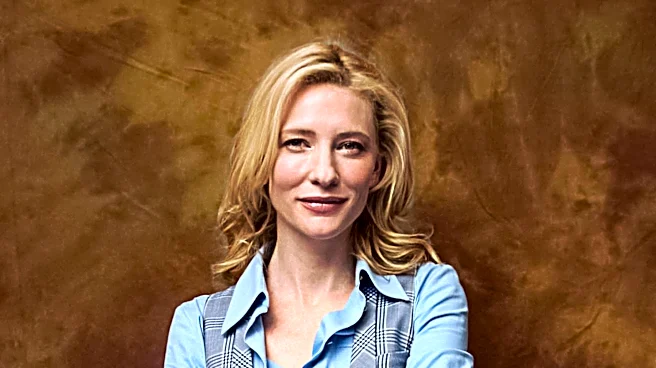
The Human Consent Foundation (HCF), a nonprofit co-founded by Cate Blanchett, along with a group of Hollywood companies and stars, has filed an amicus brief in the New York Times' lawsuit against OpenAI and Microsoft. The brief, submitted in the Southern
District of New York, challenges the tech companies' assertion that it is not feasible to clear rights for content used in AI model training. The HCF argues that the creative industries already possess a 'proven infrastructure' for licensing creative works at scale and cost-effectively. Blanchett stated in the brief that the principle of consent for using one's likeness, voice, or image has always been fundamental in her 30-year career, emphasizing that consent is the foundation of creativity, not a barrier. The brief was supported by numerous celebrities, including Anne Hathaway, Emma Thompson, and Julia Roberts, and joined by organizations like CAA and the Music Artists Coalition.
Why It's Important?
This amicus brief is a significant development in the ongoing legal and ethical debate surrounding artificial intelligence and intellectual property rights in the U.S. It directly addresses the core issue of how AI models acquire and utilize data, particularly copyrighted material and individual likenesses. The argument that a licensing infrastructure already exists for creative content could undermine OpenAI and Microsoft's 'fair use' defense, potentially setting a precedent for how AI companies must operate. If the court sides with the HCF and the New York Times, it could lead to a new framework for AI data acquisition, requiring explicit consent and compensation for creators. This would have profound implications for the U.S. tech industry, potentially increasing operational costs for AI development but also empowering artists and content creators to control their digital assets and benefit from their use.
What's Next?
The filing of this amicus brief will contribute to the legal arguments presented in the New York Times' lawsuit against OpenAI and Microsoft. The court will consider these arguments, alongside those from other parties, including a brief from SAG-AFTRA, the Writers Guild of America, and the American Federation of Musicians, which also opposed the 'fair use' claim. The outcome of this lawsuit could significantly influence future legislation and industry standards regarding AI training data and intellectual property. Tech companies may face increased pressure to develop transparent and ethical licensing models, while creative industries could see new opportunities for revenue generation from their content. The Human Consent Foundation's registry, launched in June, where individuals can log permissions for AI models to scrape their likenesses, may gain further traction as a potential solution for managing consent in the AI era.
Beyond the Headlines
Beyond the immediate legal implications, this case highlights a fundamental tension between technological innovation and established rights. The debate over 'fair use' in the context of AI training data raises complex questions about the nature of creation, ownership, and the future of work in creative fields. If AI models can freely use existing content without consent or compensation, it could devalue human creativity and labor, potentially leading to economic instability for artists and writers. Conversely, overly restrictive regulations could stifle AI development. The HCF's stance underscores a broader societal push for ethical AI, where technological advancement is balanced with respect for individual rights and creative integrity. This legal battle is not just about copyright; it's about defining the ethical boundaries of AI and ensuring that human contributions remain valued in an increasingly automated world.