


What's Happening?
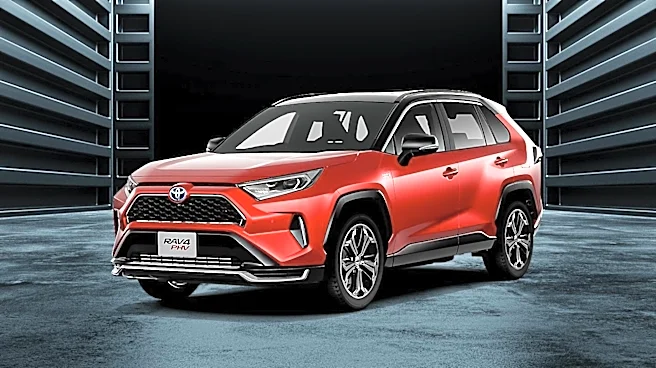
The Insurance Institute for Highway Safety (IIHS) has released updated moderate overlap crash test results, highlighting significant safety concerns for rear-seat occupants in the 2026 Audi Q3 and Toyota RAV4 PHEV. The Audi Q3 received the lowest rating
of 'Poor,' primarily due to a moderate risk of rear-seat occupant chest injury, as the shoulder belt slipped towards the dummy's neck, and the lap belt moved from the pelvis to the abdomen. The Toyota RAV4 PHEV also performed poorly, earning a 'Marginal' rating for similar reasons, with its shoulder belt moving towards the dummy's neck and the lap belt shifting to the abdomen, increasing the risk of abdominal injuries. These issues indicate that while these vehicles may perform well in other safety evaluations, they falter in protecting rear passengers in this specific crash scenario.
Why It's Important?
These IIHS findings are crucial for consumer awareness and automotive safety standards. The updated moderate overlap crash test specifically evaluates protection for rear-seat passengers, a demographic often overlooked in traditional crash testing. The identified issues with seatbelt performance in the Audi Q3 and Toyota RAV4 PHEV suggest a potential vulnerability for children and smaller adults in the rear, increasing their risk of serious injury in certain frontal collisions. This could influence purchasing decisions for families and individuals prioritizing comprehensive safety. For automakers, these results underscore the need for continuous innovation in restraint system design and overall vehicle safety, pushing them to address these specific rear-seat protection deficiencies to meet evolving safety benchmarks and maintain consumer trust.
What's Next?
Automakers, including Audi and Toyota, will likely review these IIHS findings closely. Historically, when IIHS tests reveal safety shortcomings, manufacturers often respond by redesigning components or implementing new safety features to improve their vehicles' performance in subsequent tests. Consumers considering the 2026 Audi Q3 or Toyota RAV4 PHEV may want to factor these rear-seat safety concerns into their decision-making process. The IIHS will continue to conduct and update its crash tests, driving ongoing improvements in vehicle safety across the industry. Future models or mid-cycle refreshes of these vehicles may incorporate enhancements specifically aimed at improving rear-seat occupant protection in moderate overlap frontal crashes.
Beyond the Headlines
The IIHS's continuous evolution of crash test protocols, such as the updated moderate overlap test, reflects a broader societal shift towards more comprehensive safety considerations in vehicle design. This focus on rear-seat occupant protection highlights a previously under-addressed area, as many safety advancements have historically centered on front-seat occupants. The challenge of keeping lap belts securely on the pelvis, rather than allowing them to ride up onto the abdomen, points to a complex biomechanical problem that requires sophisticated engineering solutions. This development could lead to a new generation of seatbelt technologies or interior designs that better secure rear passengers, ultimately enhancing the safety of all vehicle occupants and influencing global automotive safety regulations.