




What's Happening?
Japanese memory-chip maker Kioxia and U.S.-based Sandisk plan to invest over $31 billion (approximately JPY 5 trillion) in Japan by 2032. This significant investment aims to expand flash-memory manufacturing capabilities to meet the increasing demand
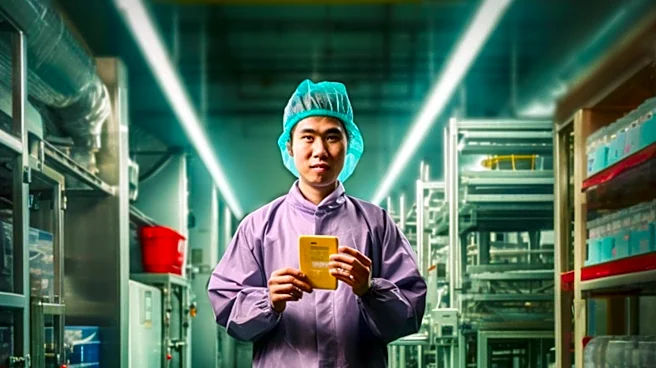
for data storage driven by artificial intelligence (AI) applications. The planned spending is contingent on support from the Japanese government and will be directed towards infrastructure and technology enhancements at Kioxia’s Yokkaichi and Kitakami plants. Kioxia has already initiated site preparation for Fab3, a new manufacturing facility at its Kitakami plant, with operations targeted to commence in fiscal year 2029. This facility is intended to boost the production of its BiCS FLASH three-dimensional NAND technology. The companies have not yet disclosed the exact division of investment, the anticipated level of government assistance, or a precise annual spending schedule, indicating that the announcement represents a long-term strategic plan rather than fully committed capital expenditure.
Why It's Important?
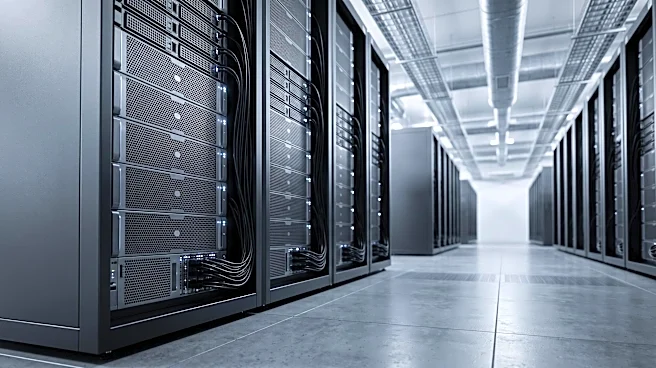
This substantial investment by Kioxia and Sandisk underscores the critical role of flash memory in the expanding AI landscape and highlights the growing capital requirements for AI infrastructure beyond just processors. As AI applications become more prevalent, the demand for high-capacity, power-efficient data storage solutions like NAND flash, used in data centers and various devices, is surging. This move is crucial for the U.S. technology sector, as Sandisk, a U.S. company, is a key player in this partnership, ensuring a continued supply of advanced memory components. The investment also reflects a broader trend of strengthening semiconductor production and supply-chain resilience, with Japan actively using public support to foster domestic manufacturing. For U.S. industries reliant on advanced memory, this investment could help stabilize supply chains and potentially reduce future costs, while also intensifying competition in the global memory market. The long-term nature of the plan, extending to 2032, signals a sustained commitment to meeting future AI-driven data storage needs.
What's Next?
The final scale and timing of the Kioxia-Sandisk investment program will largely depend on the level of Japanese government backing and evolving market conditions through 2032. The companies will need to secure the anticipated government support to fully realize their investment plans. Kioxia's Fab3 facility at Kitakami is slated to begin operations in fiscal 2029, and decisions regarding its construction schedule and equipment budget will be finalized based on market dynamics. The partnership, which has a 25-year history and has already seen over $50 billion invested in Japan, recently extended its joint-venture agreements, including payments from Sandisk to Kioxia for manufacturing services. Future developments will likely include more detailed announcements regarding government subsidies, specific production capacity targets, and the integration of new technologies to meet the demands of agentic AI, physical AI, and on-device AI, as projected by Kioxia.
Beyond the Headlines
The Kioxia-Sandisk investment highlights a strategic shift in global technology manufacturing, emphasizing the importance of geographical diversification and government incentives in securing critical supply chains. The reliance on government support for such large-scale projects indicates a growing trend where national interests and economic security are intertwined with technological advancement. For the U.S., this partnership, involving a major American company, signifies a collaborative approach to maintaining technological leadership in the face of intense global competition, particularly from other nations investing heavily in semiconductor production. The focus on AI-driven demand for flash memory also points to the foundational role of data storage in the AI revolution, suggesting that innovations in memory technology will be as crucial as advancements in processing power. This long-term commitment could also influence future research and development in memory solutions, potentially leading to more energy-efficient and higher-density storage options, which are vital for sustainable AI growth.