






What's Happening?
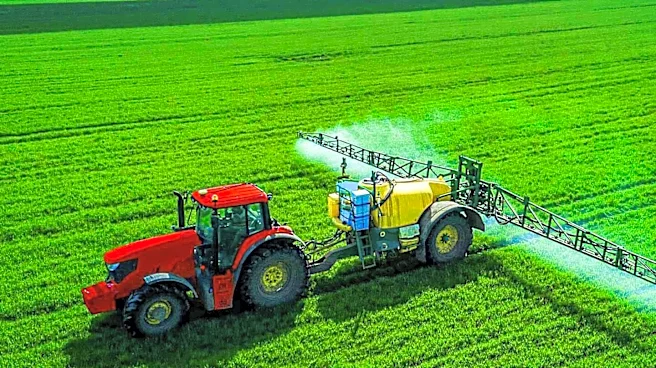
Bayer has conducted research demonstrating that its DiFlexx herbicide, which contains a safener called cyprosulfamide, offers greater crop tolerance and yield protection for corn compared to unsafened dicamba formulations. A 2020 study at Bayer's Gothenburg
Learning Center in Nebraska measured greensnap percentages in corn after applications of unsafened dicamba, safened DiFlexx, and an untreated check. The results indicated that corn treated with DiFlexx experienced less than half the greensnap compared to corn treated with the unsafened product (6.1% vs. 13.8%). Furthermore, a 2025 Bayer research trial across multiple states, including Illinois, Indiana, Iowa, Nebraska, New York, and Wisconsin, compared DiFlexx to unsafened Clarity Herbicide. This trial consistently showed that safened DiFlexx herbicide resulted in lower crop response, even at higher application rates, highlighting its advantage in corn weed-management strategies.
Why It's Important?
The findings from Bayer's research are significant for U.S. corn growers and the agricultural industry. Dicamba is a widely used tool for broadleaf weed control, but concerns about crop safety, particularly greensnap, have been a challenge. The improved crop tolerance offered by safened dicamba products like DiFlexx can lead to increased root growth and overall plant health, potentially boosting corn yields. This development could reduce economic losses for farmers by minimizing crop damage and providing more flexibility in herbicide application. For the agricultural chemical market, this research reinforces the value of safener technologies and could influence product development and adoption strategies among farmers seeking more reliable and safer weed control solutions.
What's Next?
The continued research and demonstrated benefits of safened dicamba herbicides like DiFlexx are likely to encourage broader adoption among U.S. corn growers. As farmers seek to optimize yields and minimize risks, products offering enhanced crop safety will become increasingly attractive. This could lead to further innovation in herbicide formulations, with a greater emphasis on integrated safener technologies. Agricultural extension services and industry experts will likely continue to educate farmers on the advantages of safened products, potentially influencing best practices for weed management in corn. The success of DiFlexx may also prompt competitors to invest more in developing or acquiring similar safener technologies to remain competitive in the market.
Beyond the Headlines
The development of safened herbicides like DiFlexx represents a broader trend in agricultural science towards precision agriculture and sustainable farming practices. By minimizing off-target crop damage and enhancing plant health, these technologies contribute to more efficient resource utilization and reduced environmental impact. The focus on safeners also highlights the ongoing challenge of balancing effective weed control with crop protection, a critical aspect of food security. This innovation could also influence regulatory frameworks, potentially leading to policies that favor or even mandate the use of safened formulations for certain herbicides, further shaping the future of agricultural chemical use and crop production in the U.S.