




What's Happening?
Texas Instruments (TI) has launched a new multiprotocol module, the TICS100MOD, designed to run EtherCAT, EtherNet/IP, and Profinet on a single hardware component. This module, alongside the dual-channel IO-Link master TIOM2212, expands TI's industrial
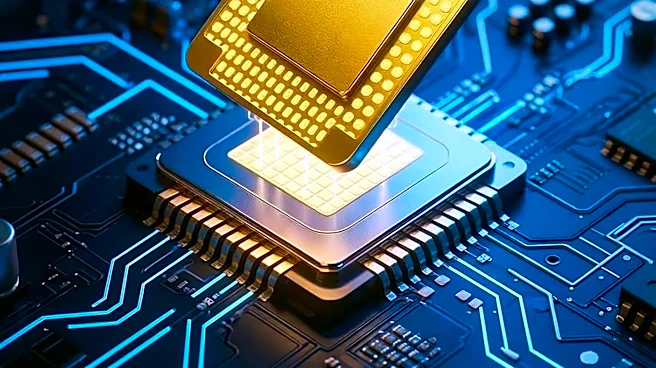
communication portfolio, targeting factory automation, robotics, and the broader industrial IoT market. The TICS100MOD is built on TI’s AM2612 microcontroller and the DP83826AI Ethernet physical layer, measuring 30x18mm, and is described as the industry’s smallest fully-featured, certified communications System-on-Module (SoM). It comes with certified, production-ready protocol stacks, allowing engineers to select the desired protocol at boot time via a firmware update, eliminating the need for hardware redesigns when switching standards. This innovation aims to simplify and reduce the cost of Industrial Ethernet integration.
Why It's Important?
This development is significant for U.S. industries involved in manufacturing and industrial automation. By consolidating multiple Industrial Ethernet protocols onto a single hardware module, TI is addressing a long-standing challenge of complexity and cost associated with multiprotocol plants. Historically, these facilities required separate hardware for each protocol, leading to increased expenses and extended engineering timelines. The TICS100MOD's ability to switch protocols via firmware updates offers a future-proof solution, allowing companies to adapt to evolving standards without significant hardware overhauls. This can lead to substantial cost savings, faster deployment of new systems, and improved efficiency in factory automation and robotics. U.S. manufacturers stand to gain from reduced supply-chain risks and streamlined long-term platform maintenance, as TI now provides comprehensive hardware layers for IO-Link, from transceivers to master devices.
What's Next?
The introduction of TI's new multiprotocol module is expected to accelerate the adoption of advanced industrial automation systems across the U.S. and globally. Manufacturers and system integrators will likely begin integrating the TICS100MOD into their next-generation designs, leveraging its flexibility and cost-effectiveness. The availability of certified protocol stacks and an industrial communications SDK will further support developers in rapid prototyping and deployment. As industrial communication continues to evolve, TI's approach of providing integrated hardware and software solutions will likely influence future product development in the semiconductor and industrial IoT sectors. The focus on reducing hardware complexity and enabling software-defined protocol selection suggests a trend towards more adaptable and scalable industrial control systems.
Beyond the Headlines
The deeper implication of TI's new module lies in its potential to democratize advanced industrial automation. By simplifying the integration of diverse communication protocols, smaller and medium-sized enterprises in the U.S. may find it easier to adopt sophisticated automation technologies that were previously cost-prohibitive or too complex. This could foster innovation and competitiveness across various manufacturing sectors. Furthermore, the emphasis on a single-vendor solution for IO-Link hardware layers could lead to increased supply chain resilience for companies relying on these components, reducing dependencies on multiple suppliers. This strategic move by TI also highlights a broader industry shift towards integrated, software-configurable solutions that can adapt to the rapid pace of technological change in the industrial IoT landscape.