





What's Happening?
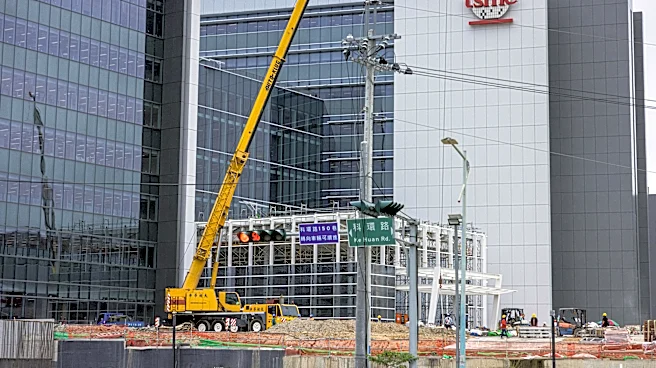
President Trump is scheduled to travel to Phoenix, Arizona, to break ground on the latest expansion of Taiwan Semiconductor Manufacturing Co.'s (TSMC) semiconductor hub. This expansion is part of TSMC's substantial $265 billion investment aimed at boosting
U.S. chipmaking capabilities, addressing an AI-driven shortage impacting American tech and auto supply chains. The project marks the fifth phase of TSMC's Phoenix site, where the company manufactures logic chips for major clients including Nvidia, Apple, AMD, Broadcom, and Qualcomm. The White House anticipates that the construction phase will employ an additional 40,000 advanced technology construction and trade workers over the next four years. Upon completion, the expansion is projected to create over 10,000 direct jobs and an additional 11,000 indirect positions within the surrounding community.
Why It's Important?
This groundbreaking event signifies a major step in strengthening the U.S. domestic semiconductor manufacturing capacity, a critical component of national security and economic competitiveness. The substantial investment by TSMC, supported by federal initiatives like the CHIPS and Science Act, aims to reduce America's reliance on foreign chip production, particularly from Asia. This move is crucial for mitigating supply chain vulnerabilities, as demonstrated by recent global chip shortages that impacted various U.S. industries. The creation of thousands of high-tech jobs in Arizona will also provide a significant economic boost to the region, fostering a skilled workforce in advanced manufacturing. Furthermore, increasing domestic chip production is essential for supporting the rapid growth of artificial intelligence and other next-generation technologies, ensuring that the U.S. remains at the forefront of technological innovation.
What's Next?
Following the groundbreaking, construction on the expanded TSMC facility in Phoenix will proceed, with a focus on employing the projected 40,000 advanced technology construction and trade workers over the next four years. The long-term goal is the establishment of 12 planned semiconductor and packaging facilities at the site, culminating in the full realization of TSMC's $265 billion investment. As these facilities become operational, the focus will shift to staffing the more than 10,000 direct jobs and 11,000 indirect positions. The success of this massive undertaking will depend on continued federal support, the availability of a skilled workforce, and the ability to integrate these new facilities into the broader U.S. semiconductor ecosystem. The project's progress will be closely watched by industry stakeholders, policymakers, and international competitors as a benchmark for U.S. efforts to re-shore advanced manufacturing.
Beyond the Headlines
The TSMC expansion in Phoenix represents a significant geopolitical and economic shift, reflecting a broader U.S. strategy to secure its technological supply chains and regain leadership in advanced manufacturing. This initiative goes beyond mere job creation; it aims to build a resilient domestic ecosystem for semiconductor production, which is vital for both economic prosperity and national defense in an increasingly technology-dependent world. The project also highlights the complex interplay between government policy (like the CHIPS Act) and private sector investment in driving strategic industrial development. The long-term implications include potential shifts in global power dynamics, as the U.S. reduces its vulnerability to disruptions in overseas manufacturing. Furthermore, the concentration of such advanced manufacturing capabilities in Arizona could transform the state into a major technology hub, attracting further investment and talent, and potentially influencing regional economic development models across the nation.